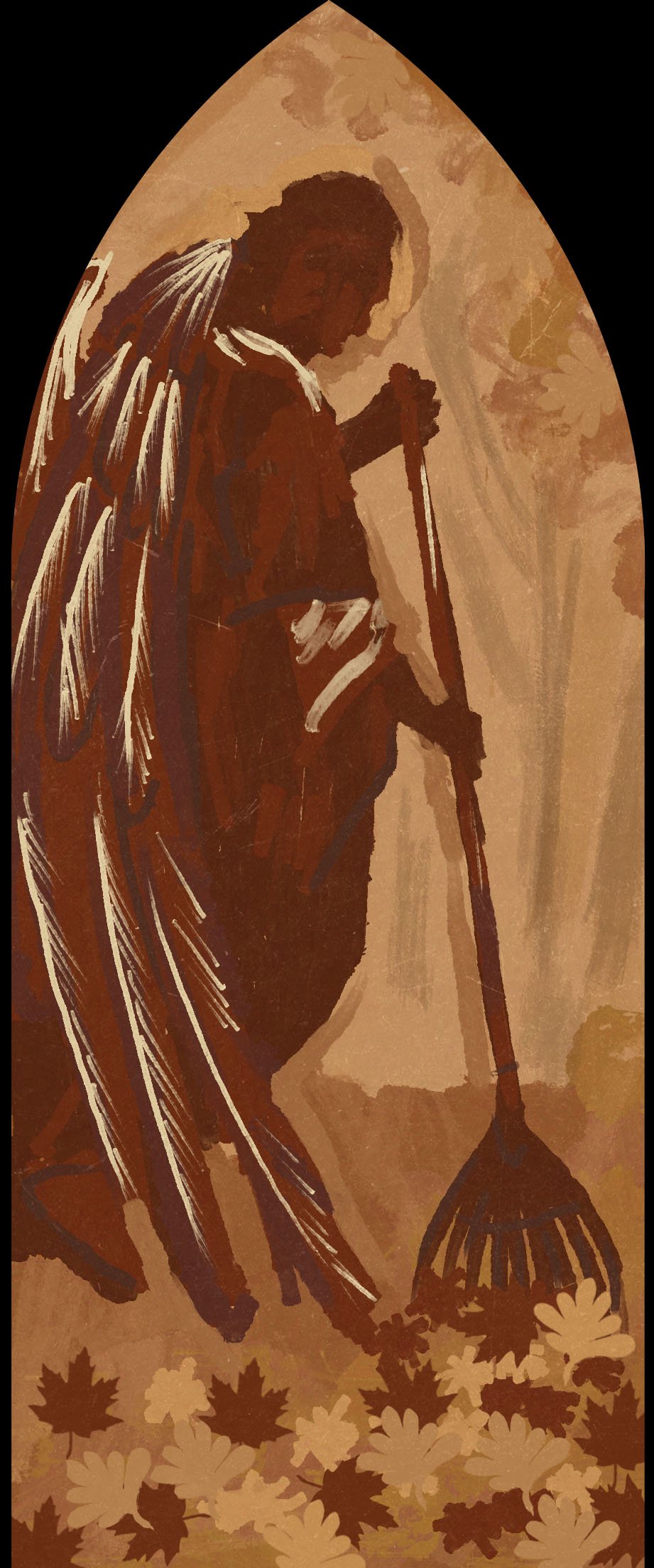
Bear with me as I guide you down a rabbit hole of thought. It could be right or wrong, but at the very least, it's theologically interesting.
Saturday morning. My dad wakes up early and decides to rake the leaves in our front yard. As a 29-year-old living back home, that means I have Saturday morning plans now. In moments like these, I sometimes experience what I like to call “being possessed by Christ.” It's an overwhelming awareness of how others feel and how I can best serve them. As I start raking the front yard, my dad uses our leaf blower to define our property line.
I look up at our neighbor Jackie's house. She had passed away just a few weeks earlier after a long battle with cancer. At her funeral service, I was moved by the many stories and testimonies of people she had served and loved so completely. Yet here I was, begrudgingly collecting the autumnal aftermath of our front yard with my father. And suddenly, a Bible verse came to mind:
“As the weeds are pulled up and burned in the fire, so it will be at the end of the age. The Son of Man will send out his angels, and they will weed out of his kingdom everything that causes sin and all who do evil. They will throw them into the blazing furnace, where there will be weeping and gnashing of teeth. Then the righteous will shine like the sun in the kingdom of their Father. Whoever has ears, let them hear” (Matthew 13:40–43).
Very intense and existential leaf-raking thoughts, I know. You can thank my Assemblies of God youth group in high school for that.
Harvesting What Exactly?
This statement from Jesus comes in Matthew 13, after he tells a parable about a farmer who sowed good seeds in his field. During the night, an enemy came and planted weeds among the good seed. When the crops began to sprout, weeds appeared alongside them. The servants asked the farmer whether they should pull out the weeds. “‘No,’ he answered, ‘because while you are pulling the weeds, you may uproot the wheat with them. Let both grow together until the harvest. At that time I will tell the harvesters: First collect the weeds and tie them in bundles to be burned; then gather the wheat and bring it into my barn’” (Matthew 13:29–30).
It's very easy to get distracted by the afterlife imagery in this parable. In verse 39, Jesus says the enemy is the devil, the angels are the harvesters, and the harvest is the end of the age. But notice how Jesus describes the good seed. He doesn't explicitly call them Christians. He calls them “the people of the kingdom.” Garry Wills argues in his book What Jesus Meant (2006) that a helpful way to understand the Kingdom of God, or Kingdom of Heaven, is as “God's reign.” When Jesus talks about the Kingdom, he means living under God's reign and authority. The people of the Kingdom live as though God truly rules them.
This brings to mind the earliest followers of Jesus, described in Acts 9:2 as belonging to “the Way.” It was a way of life. This distinction becomes especially interesting when we look at how Matthew describes judgment elsewhere in his Gospel.
The Fruits of God’s Reign
Unlike John's Gospel, which places particular emphasis on belief in Jesus, Matthew frequently emphasizes the actions that reveal a person's allegiance to God. Consider the Parable of the Sheep and the Goats in Matthew 25. The goats are sent away, not because Jesus explicitly identifies their unbelief, but because they failed to serve the poor and marginalized. They didn't feed the hungry, welcome the stranger, clothe the naked, or visit the imprisoned. You could even infer from verse 44 that the goats believed they were serving the King. Yet they are judged for their inaction.
In a famous scene from the final book of The Chronicles of Narnia, The Last Battle, C. S. Lewis explores a similar idea. Lewis introduces Emeth, a servant of the false god Tash, who encounters Aslan. To Emeth's surprise, Aslan receives the good he has done as service offered to himself. Lewis is not claiming that all faiths are equally true or that all gods lead to the same place. Rather, he is exploring the possibility that a person can respond to what is genuinely good and true without fully understanding the God behind it.
In other words, we can recognize the way of Jesus by the fruit it produces. That raises an interesting question. If God's reign is revealed through the way we live, what exactly is being judged when Jesus talks about the final harvest?
Refining Fire
In this line of thinking, salvation involves resisting Satan through our actions. For a moment, think of Satan not as the familiar figure running around with a pitchfork and horns, but through the meaning of the Hebrew word satan: “adversary” or “accuser.” In Scripture, Satan is associated with opposition to God's purposes. So, for the sake of this thought experiment, imagine Satan as representing everything that resists the reign of God—selfishness, pride, the desire to dominate others, and all the ways we choose ourselves at the expense of love.
Philosophically, the possibility of choosing against love is part of what makes freely chosen love meaningful. Perfect love cannot simply be forced. We must be free to choose it, even when something within us pulls in the opposite direction. With that in mind, consider Jesus' parables in Matthew 13 and 25 alongside this passage from 1 Corinthians 3:
“If anyone builds on this foundation using gold, silver, costly stones, wood, hay or straw, their work will be shown for what it is, because the Day will bring it to light. It will be revealed with fire, and the fire will test the quality of each person's work. If what has been built survives, the builder will receive a reward. If it is burned up, the builder will suffer loss but yet will be saved—even though only as one escaping through the flames” (1 Corinthians 3:12–15).
Paul is speaking specifically about the work built upon the foundation of Christ. But the imagery raises an interesting theological question. Could the fire of God's judgment be understood, at least in some sense, as consuming what opposes God's reign rather than simply destroying the person? Could the things we've built our identities around be burned away while the person is ultimately restored?
At the end of Revelation, God declares: “Behold, I am making all things new” (Revelation 21:5). Could what resists God's goodness be consumed, while the person is made new? I'm not suggesting that this is the only possible interpretation of these passages. Matthew's imagery of judgment is serious, and Christians have understood it in different ways. But I think the question is worth considering, especially when we think about what sanctification means for those who follow Jesus.
Learning to Let Go
For those who have chosen to follow Christ in this life, we undergo the process of sanctification. Sanctification is the ongoing process of being transformed into Christ's likeness. Or, to use the language we've been exploring, slowly surrendering more of ourselves to the reign of God. It involves learning to resist what opposes God's goodness. In this sense, sanctification is a daily struggle against the adversarial forces of selfishness, fear, pride, and sin. Perhaps this connects to what Jesus describes as “storing up treasures in heaven” (Matthew 6:19–20).
Every time we choose generosity over greed, forgiveness over resentment, or service over self-interest, we loosen our attachment to things that cannot last. We begin to trust the reign of God more than the temporary rewards the world offers. If God's final judgment exposes and removes everything that opposes his goodness, perhaps this daily surrender prepares us for that encounter. The more we learn to release now, the less tightly we cling to what cannot endure.
This isn't a unique metaphor in Scripture. Revelation 17 and 18 describe the fall of Babylon. Babylon represents more than an ancient city. In Revelation, it becomes a picture of corrupt empire, exploitation, and earthly power. As Babylon collapses, John describes people mourning its destruction. Even though the system is corrupt, those who benefited from it grieve its loss. They have become so attached to its wealth and power that they cannot imagine life without it. That's what makes this image so haunting. Sometimes the very things that are destroying us are the things we fear losing most.
I wonder if Jesus is warning us about something similar in his parables. Be an agent of God's reign. Not simply through your beliefs, but through your actions. Because who cares about your stances on abortion, queer people, or which political party you belong to if you aren't willing to be a servant? What good is being right about everything if you refuse to love anyone?
Jesus continually calls his followers to a life where faith produces something tangible, where the reign of God becomes visible in how we treat others.
Reward in Itself
Many of us read Jesus' promises of rewards in heaven and use them as motivation to endure. There's nothing inherently wrong with finding hope in those promises. But I wonder if we're sometimes missing something. Do we need a reward to do good, or do we want to live in a renewed world and consider that our reward? What if the greatest reward isn't simply receiving something for ourselves, but finally living in a world where everything has been made right?
Jesus' promise of rewards in Matthew 5 may say more about God's goodness and generosity than about our need to earn anything from him. God delights in lavishing his love on us. Perhaps the more we become like Christ, the less concerned we become with what we will receive and the more concerned we become with who we can serve.
In The Book of Joy (2016), the Dalai Lama discusses how some Christians have told him he is going to hell. He responds with the idea that hell would be a place filled with people who need compassion and help. Personally, that sounds like the spirit of Christ to me. To be willing to forget yourself, enter others' suffering, and seek their freedom. After all, isn't that what Jesus did? He didn't stay distant from a broken world; he entered it. He served people who couldn't repay him and loved people who rejected him, even to the point of willingly entering death to bring life.
Maybe that's what it really means to live under the reign of God. Not simply avoiding the fire ourselves, but becoming the kind of people who would walk into it to rescue someone else. Maybe that's where my Saturday morning leaf-raking thoughts were leading all along. I was thinking about judgment, weeds, and the end of the age. But just across the street was the memory of a woman whose life had been defined by loving and serving others. While I begrudgingly raked leaves, I was reminded of what it means to live under God's reign. Perhaps the clearest evidence of the Kingdom isn't how well we can explain the final judgment, but how faithfully we love the people standing right in front of us.