MLK Day 2026
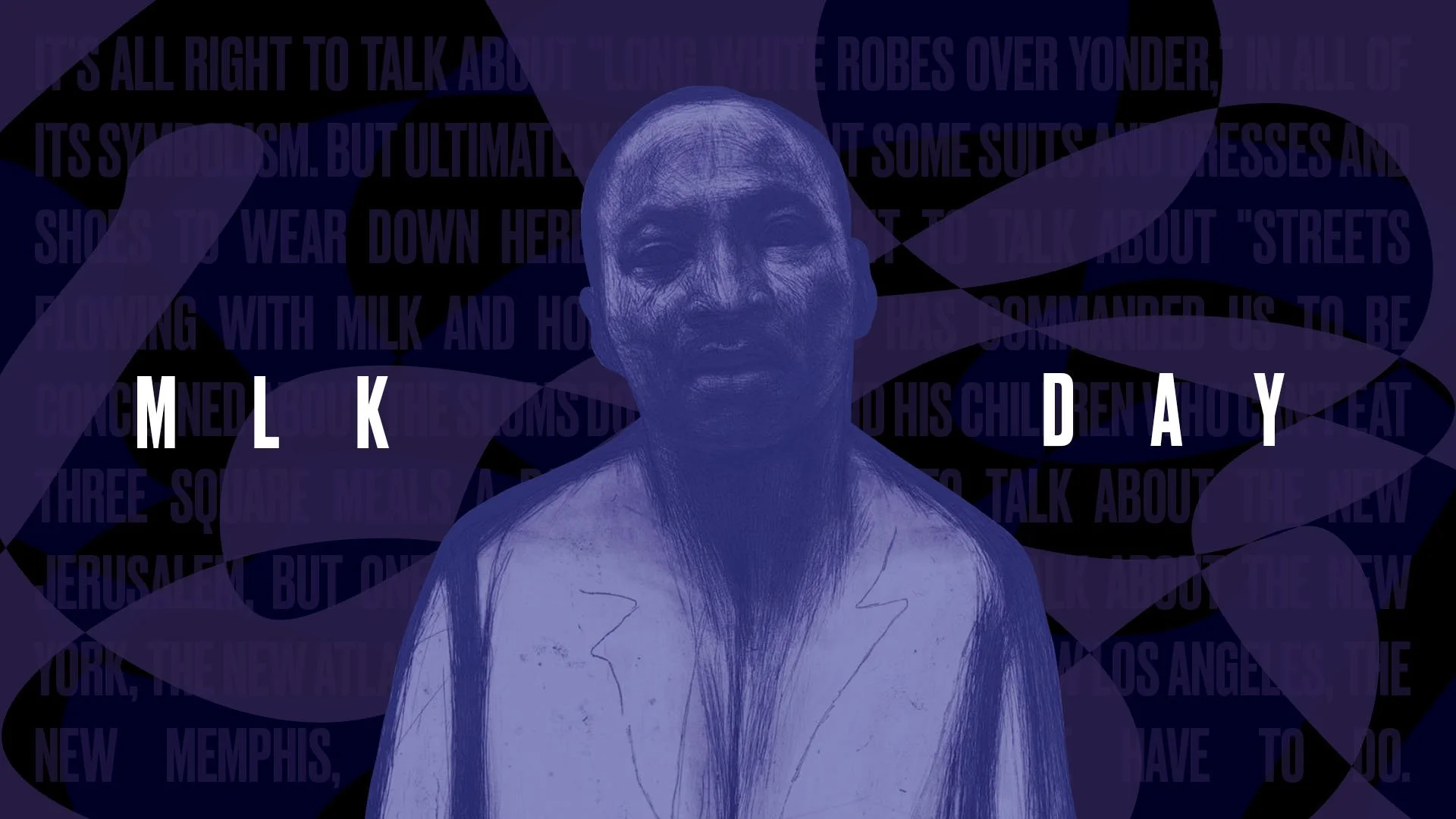
Graphic includes “Martin Luther King, Jr.”, a 2002 etching by John Woodrow Wilson
On April 3, 1968, one day before he would be assassinated, Dr. Martin Luther King, Jr. delivered a speech in support of the striking sanitation workers in Memphis, TN. There had been many threats on his life during the trip, but Dr. King remained determined to stand with public servants in their protest against the city. In his prophetic “I have Seen the Mountaintop” speech, Dr. King focuses on three things still very relevant today: the Threat, the Truth, and our Tomorrow.
The Threat

“Strangely enough, I would turn to the Almighty, and say, "If you allow me to live just a few years in the second half of the twentieth century, I will be happy…. I remember in Birmingham, Alabama, when we were in that majestic struggle... Bull Connor would say, "Turn the fire hoses on." And as I said ...Bull Connor didn't know history… that there was a certain kind of fire that no water could put out. And we went before the fire hoses; we had known water. If we were Baptist or some other denomination, we had been immersed. If we were Methodist, and some others, we had been sprinkled, but we knew water.”
Many will point out the similarities between Moses and Martin. Both guided their people through a wilderness. Both brought their communities to the edge of a promise they themselves would not enter. Most strikingly, both of their lives ended with a mountaintop moment, seeing a horizon of hope to come. But in Memphis, King’s mountaintop moment saw that the work of resistance is dangerous.
The work of liberation had already claimed Medgar Evers, Malcolm X, and Mahatma Gandhi. History was clear: people who confront unjust systems often become martyrs. In this speech, Dr. King is blunt with his audience: this work is worthwhile, but it’s dangerous. The key to overcoming the fear this danger brings is unity.
“You know, whenever Pharaoh wanted to prolong the period of slavery in Egypt, he had a favorite, favorite formula for doing it.… He kept the slaves fighting among themselves….When the slaves get together, that's the beginning of getting out of slavery.”
The Truth
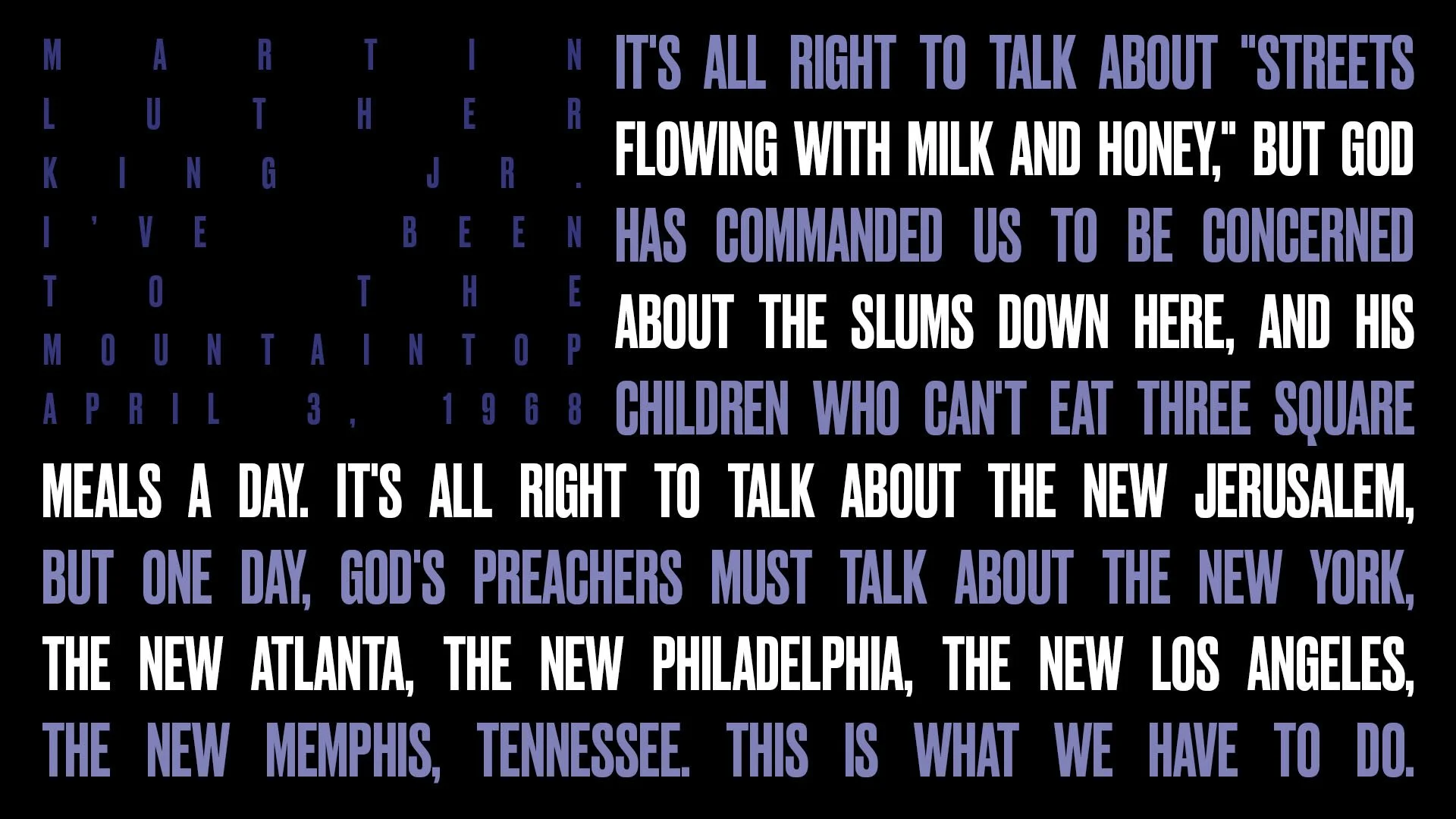
“And I'm always happy to see a relevant ministry... It's all right to talk about "streets flowing with milk and honey," but God has commanded us to be concerned about the slums down here, and his children who can't eat three square meals a day. It's all right to talk about the new Jerusalem, but one day, God's preachers must talk about the New York, the new Atlanta, the new Philadelphia, the new Los Angeles, the new Memphis, Tennessee. This is what we have to do.”
Dr. King’s fight against injustice was fueled by his faith. He didn’t see a difference between activism and following Jesus. Faith should move you to action. The real enemies of progress in King’s mind weren’t the bigoted individuals. It was the comfortable Christians who didn’t risk anything in fighting for their neighbor. King turned to Jesus’ parable of the Good Samaritan (Luke 10:25–37). In the story, a man is traveling on a dangerous road from Jericho to Jerusalem when he is suddenly ambushed and left for dead. Two holy men pass him on the road, doing nothing to help him. Only a Samaritan, someone despised, stops to show mercy. Dr. King poses different reasons why the two holy men didn’t help.
“...they were busy going to church meetings…”
Or “...there was a religious law that [Holy men were] not to touch a human body twenty-four hours before the ceremony."
“It's possible that these men were afraid. You see, the Jericho road is a dangerous road.”
But underneath their excuses was one question: "If I stop to help this man, what will happen to me?" But the Good Samaritan asks a different one, "If I do not stop to help this man, what will happen to him?” That outward shift from fear to compassion is what it means to follow Christ. The Gospel isn’t a sentimental musing; it is the reality of God that his children are to carry out.
Our Tomorrow
“…Well, I don't know what will happen now. We've got some difficult days ahead. But it doesn't matter with me now. Because I've been to the mountaintop... Like anybody, I would like to live a long life. Longevity has its place. But I'm not concerned about that now. I just want to do God's will. And He's allowed me to go up to the mountain. And I've looked over. And I've seen the promised land. I may not get there with you. But I want you to know tonight, that we, as a people, will get to the promised land.”
Martin Luther King Jr. didn’t know he would be killed 24 hours after this statement. Yet he spoke with the assurance of someone who had already glimpsed the other side of the mountain. Many will use Dr. King's legacy as a moral decoration to signal they are on the right side of history. But King was never interested in aesthetic justice. He demanded something deeper and more radical: a social and spiritual transformation that teaches us to truly see our neighbor as worthy of dignity.
He did not idolize America. But he did believe its founding claim, that all men are created equal, was a radical idea worth fighting to make real. Not for the privileged few, but for those shut out from educational, financial, and social flourishing because of race or creed. Like Moses speaking to Israel one last time, King stood on the mountaintop and saw the Promised Land. He believed it was possible, and that we could get there together.
To listen to Martin Luther King’s full “Mountaintop” speech, click here.