Walking on Water : “The Way, Truth, and Life”
“But he said to them, “It is I; don’t be afraid.” (John 6:20)
A Reflection
I’m Not Lost
On a solo trip to New York, I visited the Metropolitan Museum of Art and was impressed by its endless hallways. Room after room revealed masterpieces I had only seen in textbooks. But by the time I reached the Impressionists, I was exhausted, hungry, and ready to go. After walking in circles, I realized I couldn’t seem to leave. I kept passing the same suits of armor and medieval altarpieces over and over again. Eventually, I swallowed my pride and asked a guide for help. A few directions later, I finally found the exit.

John’s fifth sign is a lot like that moment. Jesus walking on water is one of the most iconic miracles in Scripture, yet in John’s Gospel it appears almost as a footnote, tucked between two halves of the “Bread of Life” teaching. It feels brief, almost like John assumes the audience already knows the full story from the other Gospels. But John never wastes scenes. Even in six short verses, he gives us a glimpse of Jesus as the Way.
“When evening came, his disciples went down to the lake, where they got into a boat and set off across the lake for Capernaum. By now it was dark, and Jesus had not yet joined them.” (John 6:16-17)
The other Gospels tell us Jesus sent the disciples ahead while he prayed on the mountain. That doesn’t contradict John, but it adds context. After feeding over 5,000 people, the disciples were undoubtedly exhausted. Still, they obeyed and set off across the lake, something fishermen like them had done countless times. That’s precisely the danger: when something feels familiar, we stop paying attention. They were sent by Jesus, they knew where to go, and they even knew how to do it in the dark. Who needs help when you have muscle memory? But then reality shifts.
“A strong wind was blowing and the waters grew rough.” (John 6:18)
According to David Guzik’s commentary, in other storm stories, the disciples are terrified. Here, they seem more frustrated after rowing for six to eight hours and only making it halfway across. Exhaustion mixed with obedience is a special kind of confusion. What do you do when you’re doing exactly what Jesus told you to do and everything is pushing against you? What do you do when you know the way forward but can’t seem to get there?
The Way Through Waves
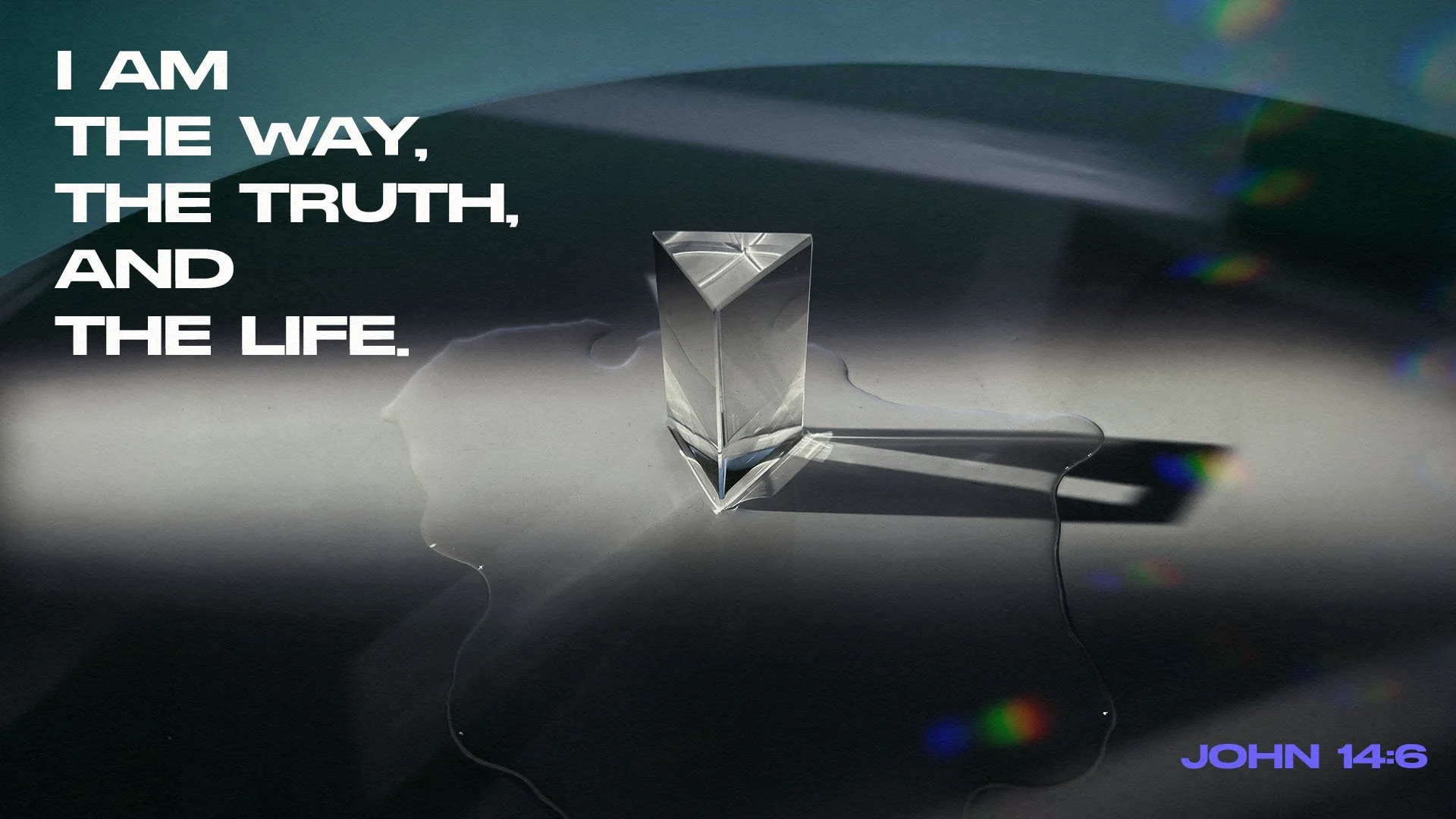
In John 14, Jesus is at his Last Supper with the disciples. He tells them he is going away, and Thomas asks Him to share the way to where he is going. Then Jesus answers with his famous line, “I am the way, the truth, and the life. No one comes to the Father except through me” (John 14:6). For many, that line is reserved for conversations about salvation or for defense against other religions. But as an answer to Thomas’ question, it’s strange. Thomas asks for a map; Jesus answers with Identity. But how does that help the disciples fighting wind and water in chapter six?
As mentioned throughout this series, John loves a callback to the Old Testament. The entire sequence of John 6 echoes Exodus. The feeding of the 5,000 points back to manna in the wilderness. This storm scene mirrors the crossing of the Red Sea. In Exodus 14, the Israelites have just escaped slavery. God leads the caravan of millions of freed people through the desert, only for them to hit a massive obstacle: the Red Sea. Behind them, Pharaoh’s army closes in, trying to bring them back. They obeyed God, and now it feels like a trap. But God makes a way where there was none, splitting the sea in two so they could safely pass through.
Back to the disciples: they’re obeying, they’re rowing, but instead of Pharaoh’s army, the wind is against them. But now, instead of a way being made through the water, the Way appears walking on the water toward them! “When they had rowed about three or four miles, they saw Jesus approaching the boat, walking on the water; and they were frightened. But he said to them, “It is I; don’t be afraid.” (John 6:19-20)
This sign is different! Jesus doesn’t multiply food, speak a sentence, or perform a long-distance miracle. He steps into real danger and joins them in the storm. John has already said, “For the law was given through Moses; grace and truth came through Jesus Christ.” (John 1:17) With Moses, God sent words written on stone. With Jesus, God sends presence into the waves.
Get in the Boat
“Then they were willing to take him into the boat, and immediately the boat reached the shore where they were heading.” (John 6:21)
Once the Way gets into the boat, the strain ends. Some of us are rowing with everything we have. You’re exhausted, obedient, determined, and yet going nowhere. Not because we’re rebellious, but because we’re rowing alone. So the question isn’t, “Do you believe in the Way?” in the typical evangelical sense. The question is more practical: Are you tired enough to let Jesus into the boat? Jesus as the Way isn’t primarily about saying the right prayer to get to Heaven. It’s about following his way of being. His posture, his rest, his courage, his surrender. That is what leads to Truth. That is what leads to Life.
Take With You
“My Father’s house has many rooms; if that were not so, would I have told you that I am going there to prepare a place for you? And if I go and prepare a place for you, I will come back and take you to be with me that you also may be where I am. You know the way to the place where I am going.” (John 14:2-4)
Most of us have been handed a particular image: Heaven as an exclusive nightclub and Jesus as the bouncer with a clipboard of approved names. The secret password is the “sinner’s prayer,” and if your name isn’t on the list, good luck getting past the rope. Our cultural imagination of Jesus’ words has been shaped by street-corner preachers, altar calls, and turn-or-burn rhetoric. But doesn’t it seem odd for Jesus to call himself “the Way”?
Right before Jesus says this, he talks about his “Father’s House.” Many Christians were taught to imagine this as mansions in heaven. But Jesus isn’t talking about real estate. He’s talking about dwelling. John begins his Gospel with, “The Word became flesh and made his dwelling among us.” (John 1:14) That word dwelling literally means “to pitch a tent.” John is pointing back to the Tabernacle, the tent Moses built in the wilderness so Israel could meet with God. John is saying that Jesus’ very body was a Tabernacle in the flesh, God choosing to camp with humanity.
That trajectory doesn’t stop with Jesus. After saying, “I am the Way,” Jesus immediately promises the coming of the Holy Spirit. The movement of the Gospel is not us going up to God, but God making his home in us. “On that day you will realize that I am in my Father, and you are in me, and I am in you. Whoever has my commands and keeps them is the one who loves me.” (John 14:20-21a)
When Jesus says “I am the Way,” he isn’t offering a password to get into Heaven; he’s talking about his way of being in the world. The disciples expected the Kingdom of God to arrive through force, politics, and nationalism. As Jews under Roman occupation, they imagined victory would look like Rome being driven out and Israel restored as a nation. Jesus disrupts that expectation completely. In his ministry, he never punishes anyone; he heals. He never excludes Romans; he praises the faith of a centurion. He never condemns people to Hell; he warns religious leaders of their destructive behavior. Jesus reveals that the Kingdom comes through presence, healing, and reordering our values.
Before followers of Jesus were ever called “Christians,” they were called “the Way.” All they had were stories of what Jesus did and a commitment to imitate him. Acts 2:42–47 describes what following the Way looked like in practice: “They devoted themselves to the apostles’ teaching and to fellowship, to the breaking of bread and to prayer… All the believers were together and had everything in common… They sold property and possessions to give to anyone who had need… praising God and enjoying the favor of all the people…” In other words, the Way was a way of living, being with each other, and of embodying God’s presence in the world.
Guzik, David. “Enduring Word Bible Commentary John Chapter 6.” Enduring Word, 8 July 2025, enduringword.com/bible-commentary/john-6/.