

Things: Money and Wealth

What Are You Holding?
Money, Wealth, and the Upside-Down Kingdom in the Gospel of Luke
Every single one of us carries privilege. And every single one of us carries prejudices against us that we did not choose and cannot always control. Some of those things are inherited. I know this personally.
I am a first-generation American, the daughter of Indian immigrants. My parents are college-educated, working in medical and medical-adjacent fields, and they earned their citizenship in a political moment where that is not something any of us should take for granted. I was born in the United States. I inherited my faith. I grew up in a cultural community where my ethnic identity and my faith system were so intertwined that there was no separation between them. To be Keralite (Indian) and to be Pentecostal (Christian) were, for a long time, the same thing to me.
I also grew up with a scarcity mindset, but was urged to be a part of the "model minority," a term I have come to understand as degrading rather than honoring. It is a category built on subservience, designed to position people of the Global South within a racial hierarchy that was never constructed for our dignity. It places us just high enough to serve as a wedge and just low enough to remain compliant.
I share all of this because exploring what it means for rich and poor in the Gospel of Luke requires honesty about where each of us stands when we open the text. I come to this with privilege. I also come to this with the particular poverty of being told, in ways subtle and direct, that I do not quite fit: not Indian enough, not American enough, not the right kind of Christian girl by the standards of my tradition. Rich in some ways and poor in others. And as it turns out, that is exactly the tension Luke wants us to sit with.
It Starts Before Jesus Says a Word
First, consider who this book is actually for, and who gets to open it.
The first to announce the coming kingdom is not a king, priest, or scholar, but a poor, unmarried teenage girl from Nazareth, a place often dismissed. Through her, the revolution is announced.
Mary sings:"He has brought down the mighty from their thrones and exalted those of humble estate; he has filled the hungry with good things, and the rich he has sent away empty."(Luke 1:52-53, ESV)
Mary’s song is rooted in Old Testament prophecy, echoing the Psalms and Isaiah, where God sides with the lowly. She recognizes God's promise is coming to pass, not inventing something new.
To understand who Mary sings for, consider the Hebrew word ‘ani. The Bible Project describes this word as Israel’s poor and lowly: not only those without money, but those lacking power: widows, orphans, foreigners, the sick, and the outcast.
This theme of reversal, God’s favor for the marginalized, emerges even in Jesus’s genealogy. Christ’s lineage includes the overlooked, underscoring the upside-down Kingdom and centralizing the poor in Luke's message.
The Mission Statement
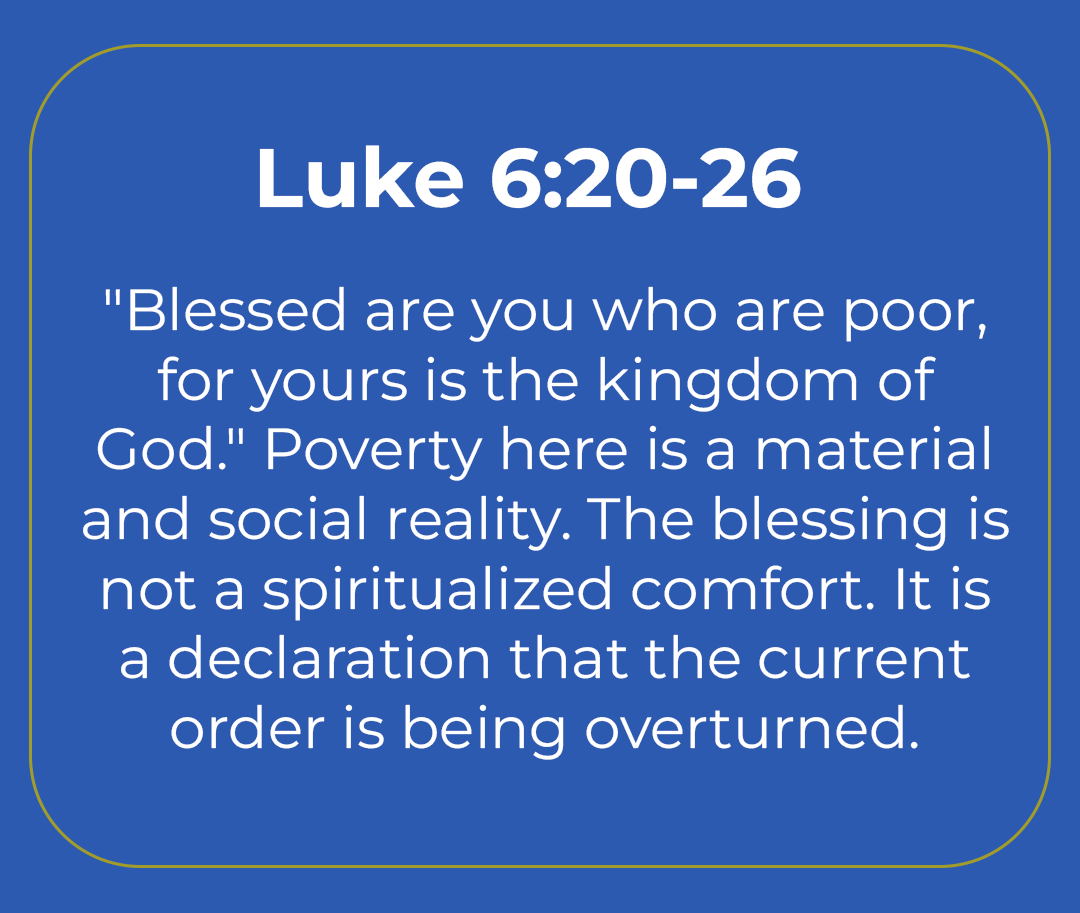
The grassroots movement of rich and poor in Luke begins in chapter 4, as Jesus stands in the Nazareth synagogue, reads from Isaiah 61, and fulfills that ancient prophecy:
"The Spirit of the Lord is upon me, because he has anointed me to proclaim good news to the poor. He has sent me to proclaim liberty to the captives and recovering of sight to the blind, to set at liberty those who are oppressed, to proclaim the year of the Lord's favor."…Then he sits down and says: "Today this Scripture has been fulfilled in your hearing."(Luke 4:18-19, 21 ESV)
This is more than a dramatic moment. Jesus revives an ancient practice God gave Israel to shape them as his people through freedom and liberty, as expressed in the Greek word aphesis.
Jubilee, as described in Leviticus 25, required Israel to cancel debts, free slaves, and return land every 50 years. This was a covenant obligation, not charity, and was designed to correct power imbalances and protect the vulnerable by resisting hoarding.
For Jesus to claim this passage as his mission is transformative. He revives a forgotten promise and calls for a dramatic reversal of social hierarchy, embodying the Kingdom’s upside-down logic.
This Kingdom logic subverts worldly systems and empire. Jubilee isn’t about individual gain but about communal transformation, where resources are reallocated to serve the whole. Luke’s gospel insists: the upside-down Kingdom inverts self-serving accumulation of wealth.
A Seat at the Table Was Never Decorative
What strikes me is that Jesus is not simply inclusive, but intentional in his inclusion. He challenges everyone he meets to do the same.
Luke, a Gentile physician writing to Gentiles, frames his account through his own lens of privilege and marginalization.
And so it is no accident that in Luke, shepherds, who occupy one of the lowest rungs of the social hierarchy, are the ones who hear the birth announcement first. A Samaritan, who serves as the ethnic villain in so many cultural narratives of the time, is the hero of the compassion story. A foreign leper is the only one among ten who returns to give thanks. A widow, who in these societies has virtually no social standing or economic protection, is the one whose persistence finally breaks through an unjust judge, someone with all of the power and none of the accountability.
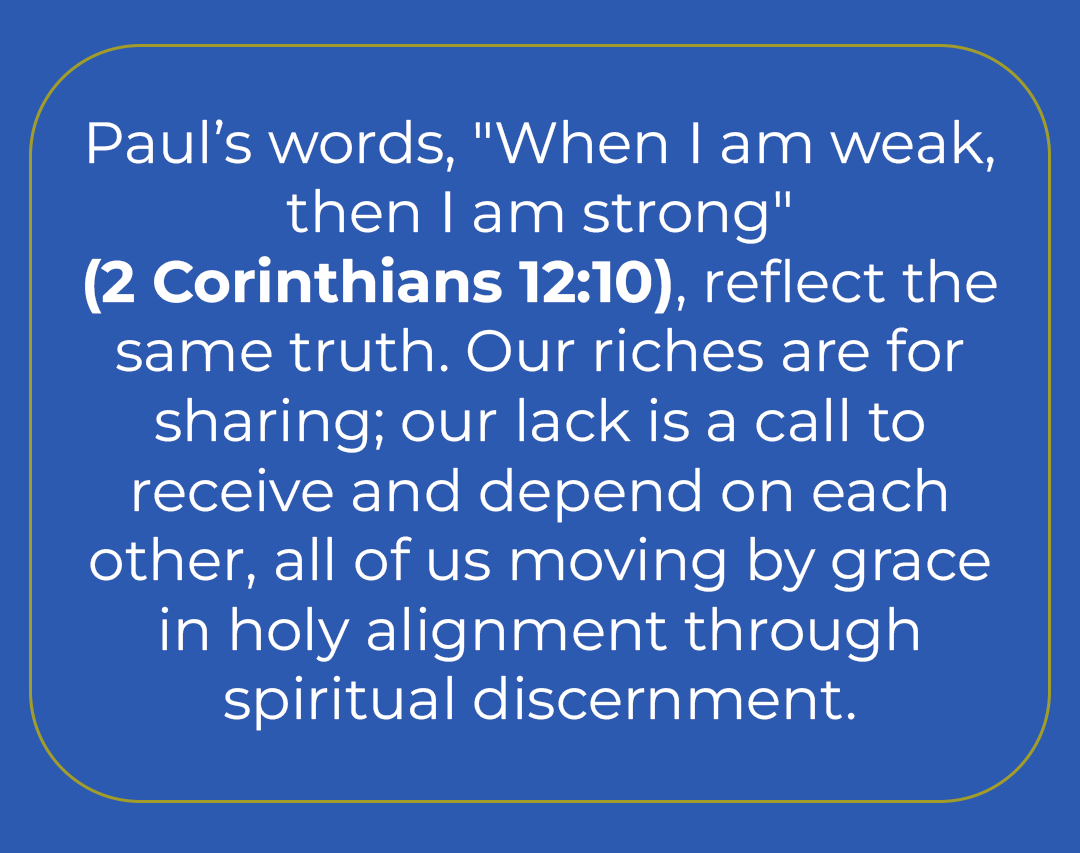
Every single one of them is not just “poor”, but the Greek word used is ptōchois. Its meaning is a total dependence on charity, akin to the Hebrew identifier ‘ani, and every single one of them is Luke's answer to the question of who God's kingdom is actually for.
What is most important is that redemption extends not only to those facing evil but also to those who built it. Jesus doesn’t simply liberate the oppressed or condemn the oppressor; he challenges those with power to change systems they have benefited from. The rich young ruler is invited, not condemned, before leaving (Luke 18:18-25). Zacchaeus is welcomed before any change (Luke 19:1-10). The Kingdom welcomes all, though the cost is different for everyone, depending on what they are holding.
Jesus offers participation not as symbolism, but as real citizenship in a reordered Kingdom. Luke’s grassroots movement re-centers status, intertwining power and need within servant leadership.
Jubilee as Cosmic Reset
Luke’s convergence of the upside-down Kingdom and jubilee reframes biblical restoration: true restoration is rooted in reversal, making the marginalized central and leveling power dynamics as part of God’s plan.
Jubilee was more than policy. In Luke, every jubilee moment points to Jesus’s ultimate reversal: a cosmic reset.
And this reset is a challenge that moves in both directions. For those who are rich in finances, status, power, religious pedigree, or in any of the countless ways a person can accumulate more than they need, the call is to recognize what they are holding and to release it. To receive the grace and favor they have been given, not as something they earned, but as something they are now responsible for giving. For those who are poor, in any of those same ways, the call is equally real: to recognize that they are allowed to ask, and that asking is not weakness. It is faith.
When the rich release and the poor receive, when people move from serving empire to serving the Kingdom, holy reversal occurs. Community takes shape as people, rich in some ways and poor in others, feed one another and reconcile across worldly divisions. The organizing principle is no longer accumulation, but allegiance to one King, radically remaking the hierarchy.
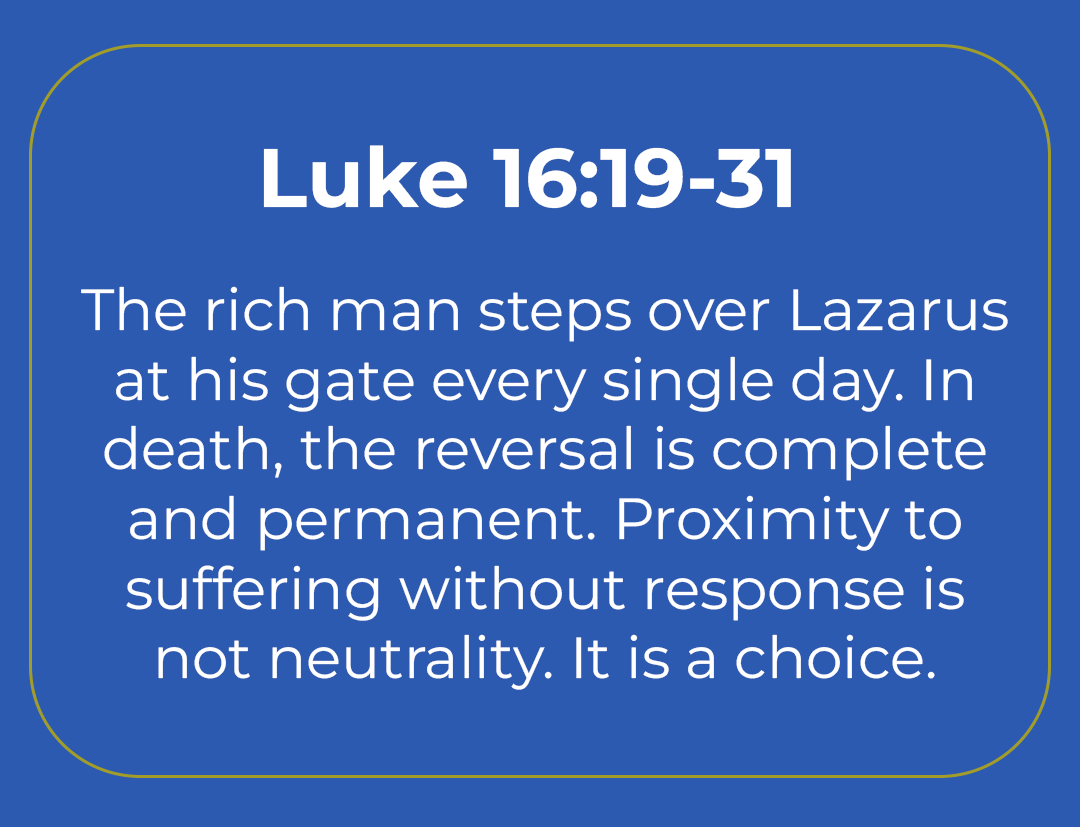
The question Luke leaves every reader with is not whether you are rich or poor by the world's standards. It is what you are depending on that is not God, and what it would cost you to let it go. Jesus makes this plain in Luke 10:27 (ESV)when he summarizes the entire law for the rich and the poor alike: "You shall love the Lord your God with all your heart and with all your soul and with all your strength and with all your mind, and your neighbor as yourself."
You cannot love God without loving your neighbor. You cannot love your neighbor without loving yourself. You cannot love yourself without loving God. These things are so deeply intertwined that they feed off each other, and the moment-to-moment choosing of Christ over all else is exactly that: a choice made moment to moment, in a world that still shows us injustice daily. However, the grassroots movement Jesus was building was antithetical to every system that measured a person's worth by worldly standards.
In conclusion, the heart of every gospel is this: we are all created in the image of God, the imago Dei ofGenesis 1:27. We are all covered by the sacrificial redemption poured out through the blood of Christ, which has adopted us into a peace that surpasses understanding. And with that peace, and for the love of God and others, we have covenant: the daily, moment-to-moment choosing of God above all else.
None of this is easy. Jesus preached the Kingdom and died at the hands of empire. He lived in a society where social inequality thrived. None of that has changed since the dawn of brokenness between humanity and God. But the hope remains: that we are all saved by grace, and that we all stand the same distance from God regardless of what makes us rich or poor by any other measure.
So may God bless you to see what you are rich in, that you may freely give. And may God renew the hearts of those around you to recognize what you may be poor in, so that when you ask, you can also receive. That is the grassroots movement of the Gospel of Luke. A connectivity that started in creation, resolved itself through covering, and continues in every day covenant.

ABOUT THE AUTHOR
Princy Prasad is a researcher, author, and ministry practitioner. She holds an MA in Ministry in the Global City from City Seminary of New York and is completing her first book, Be a River, Not a Lake, on why second-generation South Asian Americans stay or leave their ethnic churches. She can be found at @madebyprincy on Instagram or click here.