Lazarus’ Tomb
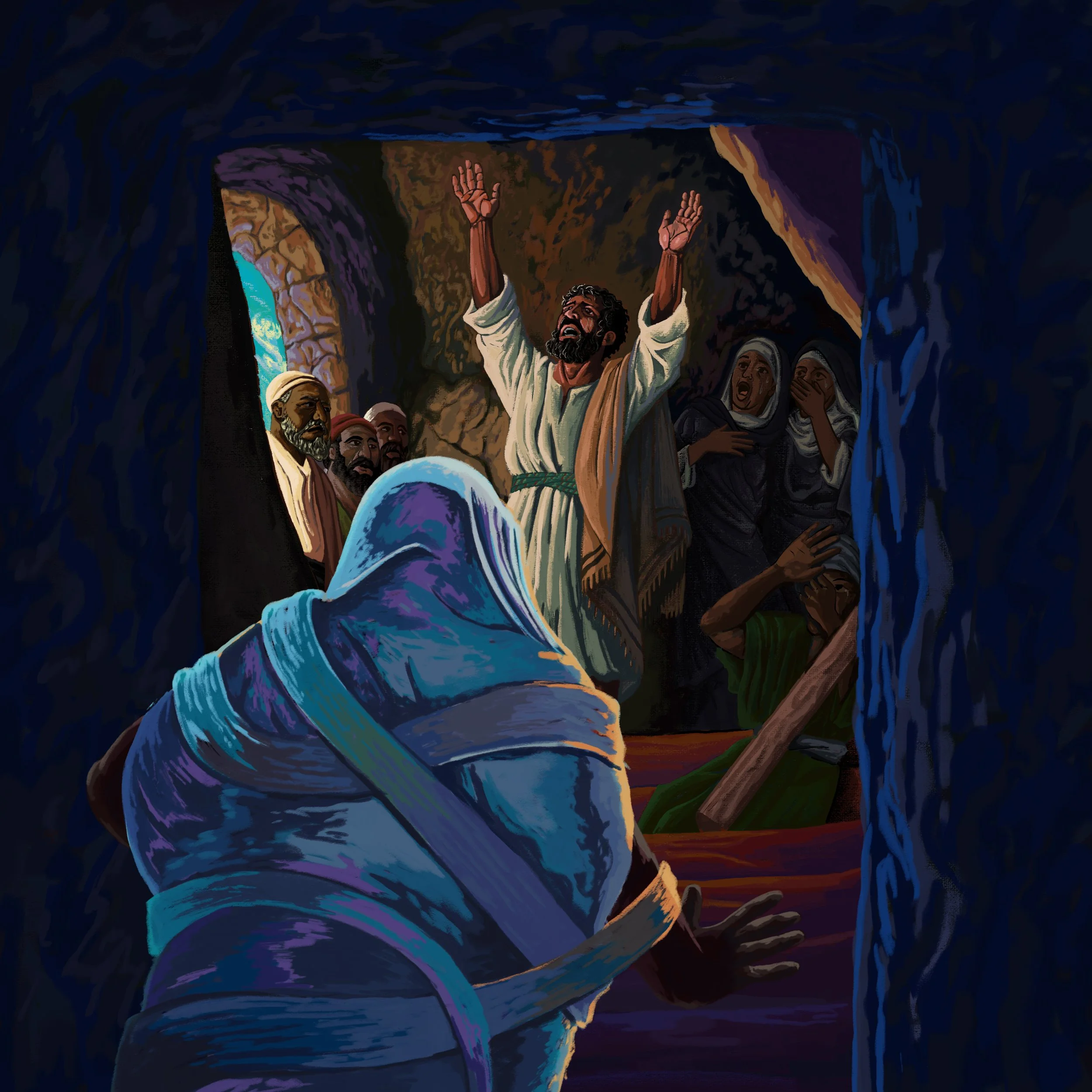
Original painting by Julius Shumpert
Jesus, once more deeply moved, came to the tomb. It was a cave with a stone laid across the entrance. “Take away the stone,” he said.
What sets the Bible apart is the depth at which its claims can be examined. Archeology and the Bible have always had a clarifying relationship. Specifically, studies and excavations around Palestine have provided a clearer picture of what Jesus’ world was like. The ancient authors of the four Gospels were discussing real people and events, whose footprints are captured in the many locations associated with them. The story of Lazarus’ resurrection has always been a favorite of mine, but delving into the research of the venerated site of his tomb in Bethany has given me profound spiritual insight into the significance of this miracle.
The Shape of the Tomb
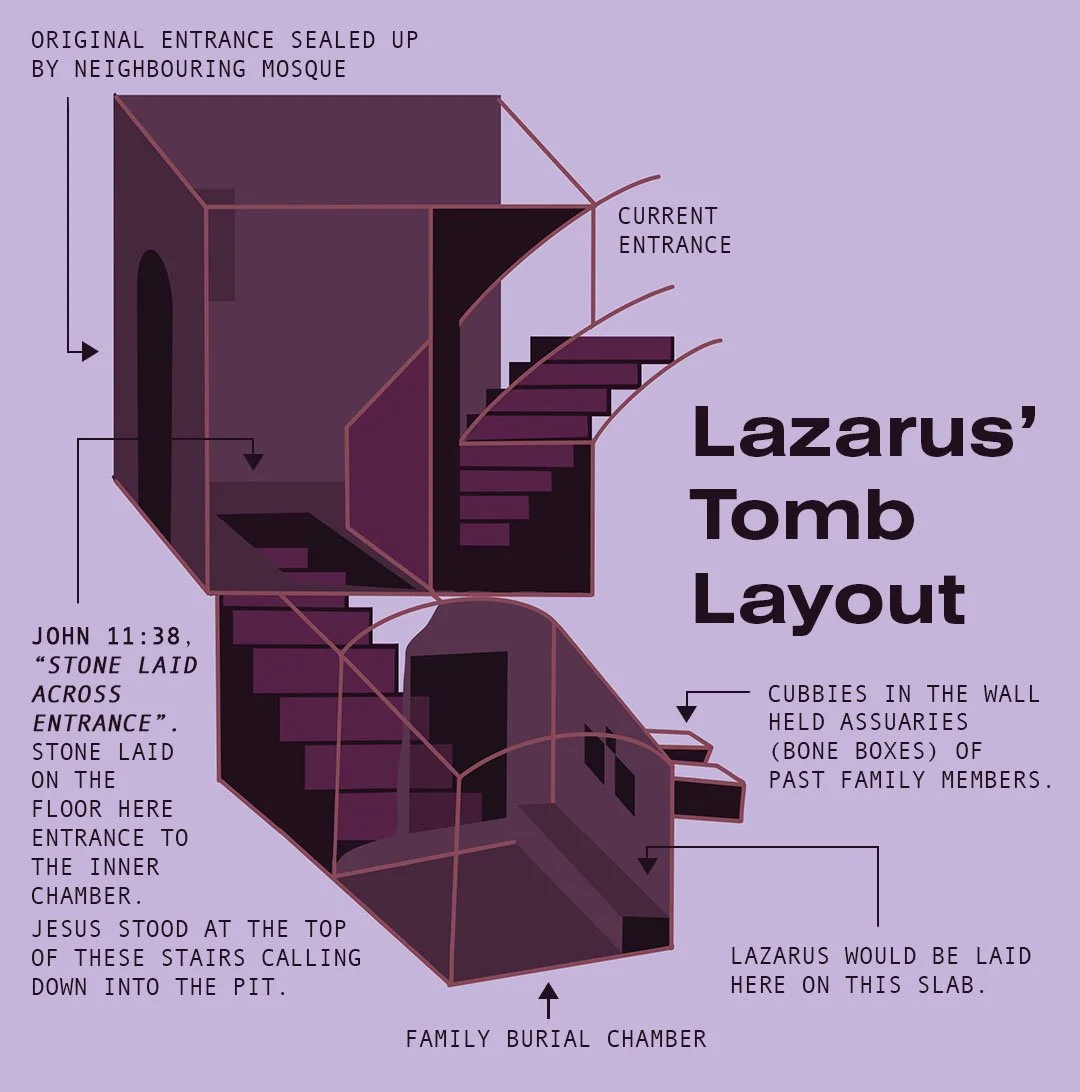
If you’ve ever attended a Sunday school class, flipped through a storybook Bible, or seen a Jesus film, you have seen an illustration of the story. Jesus usually stands outside the opening of a cave where a large round stone has been rolled away. We often think of Lazarus’ tomb looking similar to Jesus’ in this way. John 11:38 even seems to confirm these suspicions: “It was a cave with a stone laid across the entrance.”But the site in Bethany attributed to Lazarus’ tomb functions more like a family mausoleum than a singular tomb. In fact, most cave tombs were carved with the expectation that multiple family members would eventually be buried there. There would usually be a stone bench carved into the wall for the freshly wrapped body to be laid. Then, after about a year of decomposition, the family would return to collect the bones of the loved one and place them in an ossuary (bone box), which was then sealed and placed into a carved cubby in the wall.
The Lazarus family tomb site is much like this, with some key differences. Watch a walkthrough here. Firstly, the stone wouldn’t have been rolled across the entrance of the cave on the outside. Instead, you could enter a lobby area first, which has two access points. The entrance from Jesus’ time has since been sealed by a Mosque which was constructed against the original front. Another narrow entrance is accessible from a higher street and requires you to climb down into the main pit of the lobby area. This is where pilgrims access the tomb today. While Jesus probably entered from the now sealed door, imagine the image of the Savior climbing down into the depths of sorrow. It’s dark, cold, and smells of decay. But what was Jesus approaching?
The family chamber where Lazarus was laid was essentially a hole in the stone floor with stairs that required a person to squeeze and contort to fit down into the depths. This pit in the floor was covered by a large stone laid on the floor against it. This is the cave John is referring to in his Gospel. “It was a cave with a stone laid across the entrance.” Jesus stands looking down at the stone and turns back to Martha in the darkness of the cave and says, “Take away the stone”.
The Shape of Their Grief
Let’s zoom out for a second. The story goes that Jesus arrives four days late to Mary and Martha’s house in Bethany. They had requested that he come and heal Lazarus, who was very sick, but not only did Jesus arrive late, he also waited until the news of Lazarus’s death. Martha rushes at the first word that Jesus is nearby to confront him. The conversation found in John 11:17-35 is emotionally raw and honest. Think of the courage that it took the sisters to take Jesus to the place of their disappointment. Even our compassionate Savior takes a moment to weep with them. Down, down, down, does my Jesus climb. Into the depths of their doubts, disappointments, and fears.
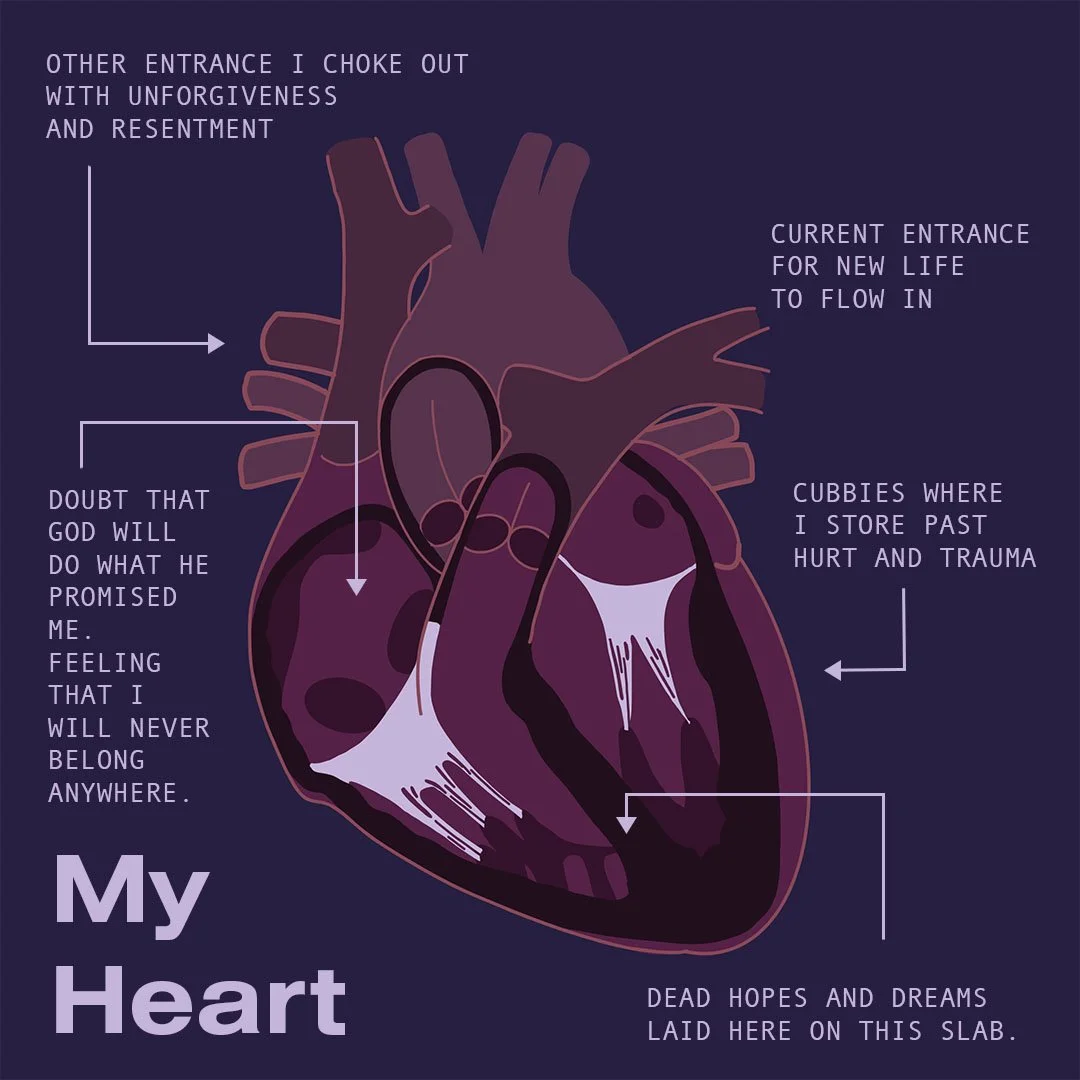
When I look at the layout of the tomb, with all its chambers, alcoves, and passageways, I am reminded of my heart. I’m not a medical doctor, nor do I have any deep knowledge of human anatomy. But I have seen the general functions of the heart. It pumps blood through the body, delivering oxygen and nutrients to cells while removing carbon dioxide and waste. It does so with different atriums and ventricles (chambers) that lead out to the body by different arteries (passageways).
The heart is also where the spiritual and the physical meet. There are spiritual chambers of your heart; places just like Lazarus’s tomb where you bury hopes and dreams. Maybe it’s not a physical bone box, but they are shelved away, never to be opened again. Maybe you have a stone of trauma blocking a freshly dead belief you held so strongly.
Mary and Martha stand in the tomb with Jesus. Crowds push in to see what’s happening at the door, but most of them can only hear as the room is tight. In front of everyone, Jesus, with tears in his eyes, points to the stone and asks for it to be moved.
“But, Lord,” said Martha, the sister of the dead man, “by this time there is a bad odor, for he has been there four days” (John 11:39).
But Lord, the trauma of what was done to me is too much.
But Lord, I was foolish and made a mistake that I’m still paying the consequences for.
But Lord, you should know the shame I will feel when you see the thoughts that go through my head.
Vulnerability is the only way for Resurrection to happen. To invite Jesus down into your disappointments is one thing, but to be fully open and honest is another. Not holding anything back from the one who brings full restoration will feel risky. But he only heals what you bring him.
The Shape of Restoration
Imagine when the miracle happens. The crowd at the door heard Jesus call out for Lazarus. Jesus’s hands are raised, and tears stream down his face as he leans on his Father to move. Mary and Martha cling to each other. A powerful wind blows through the cavern and wafts the odor of decay away. Shuffling can be heard from inside the pit until a hand emerges on the steps. Remember, to get into the chamber where Lazarus was laid, a person would have to climb and squeeze their way down. So, the disoriented and revived Lazarus has to squeeze up the stairs to be obedient to Jesus’ call. Resurrection took work! That’s why Jesus says, “Take off the grave clothes and let him go.” Community is essential to resurrection. People who can help pull you out of what you’ve been stuck in, counselors who can help you process the hard feelings, and a spiritual family that can remind you of your purpose. Resurrection isn’t a solo event. It takes people on the outside to help you out of the pit.
Lazarus’ tomb looks a lot like my heart. It looks a lot like yours, too. Inviting Jesus into the disappointments only works if you are willing to be honest. In your relationship with God, he cares more about honesty than your performance.