What Did Jesus Look Like?
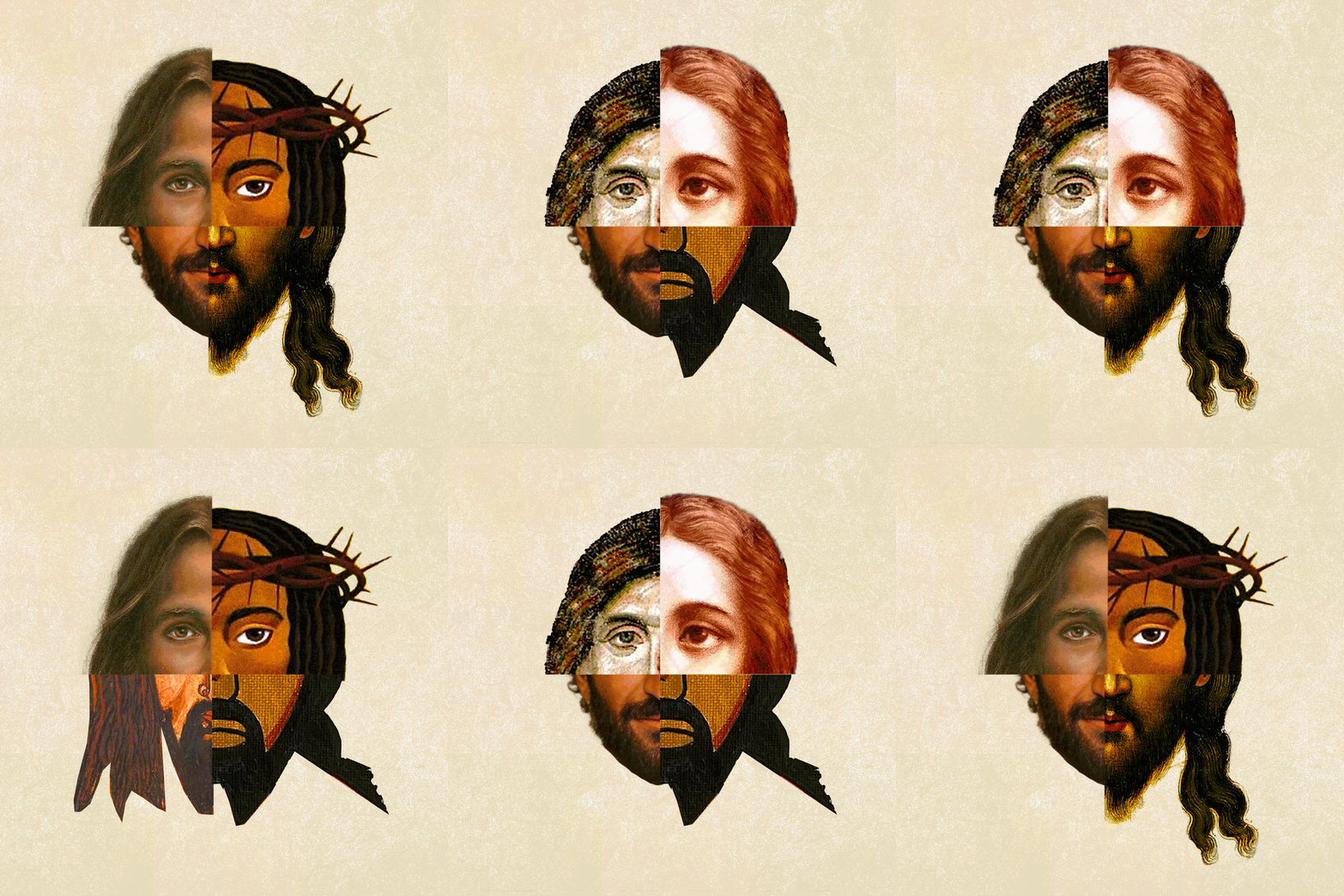
The face of Jesus and how he has been portrayed has a long, complicated history. However, the question remains: What did the Son of God actually look like? The Early Church kept no detailed record describing Jesus’ physical appearance. Some of the oldest surviving depictions of Jesus exist in the Roman catacombs and are largely symbolic. They portray him using the popular Greco-Roman visual language of the time. In some of these early images, Jesus appears as a clean-shaven youth, resembling familiar artistic depictions of shepherds, legendary figures, and various Roman gods. The earliest Christians seemed more concerned with what Jesus represented than with preserving the specifics of his appearance.
Early debates about Jesus's physicality also emerged within the Church. Some groups associated with Gnosticism argued that Christ could not have possessed a truly physical body and that his human appearance was somehow an illusion. The writings attributed to the Apostle John strongly emphasize the opposite: “The Word became flesh and made his dwelling among us” (John 1:14).
While the Bible is mostly silent about the particulars of Jesus’ appearance, it offers a few clues.
His Face
Matthew 1:1–17 and Luke 3:23–38 give us Jesus' genealogies. While the genealogies have theological purposes beyond simply recording ancestry, they include people from different ethnic backgrounds who become part of the family line of Abraham and David. Matthew and Luke also confirm that Jesus was born in Bethlehem in Judea and raised in Nazareth in Galilee.
When Jesus returns to the town where he was raised, the people ask: “Isn’t this the carpenter?” (Mark 6:3). “Carpenter” is translated from the Greek word tekton, which can describe a craftsman or builder. Regardless of the specific trade, Jesus is described as someone who worked with his hands outside in the hot sun, like his earthly father, Joseph.
In Gethsemane before the Crucifixion, Matthew 26:48 says that Judas arranged a signal to identify Jesus to the guards. In John 18:4–6, Jesus even approaches the guards and asks them who they are looking for. These scenes suggest something important: Jesus probably did not look dramatically different from the other Jewish men around him.
Many have also pointed to John’s vision of Christ in Revelation 1:14–15: “The hair on his head was white like wool, as white as snow, and his eyes were like blazing fire. His feet were like bronze glowing in a furnace, and his voice was like the sound of rushing waters.” Some Black Christian traditions and groups have pointed to this passage when discussing the ethnicity and appearance of Jesus. However, Revelation is apocalyptic literature and is filled with symbolic imagery. Christ’s hair being “white like wool, as white as snow” connects his appearance with wisdom, purity, and the imagery of the Ancient of Days in Daniel 7. His fiery eyes communicate penetrating judgment and discernment, something Jesus demonstrates in the following messages to the seven churches. His feet like glowing bronze are likewise part of this larger image of divine strength and glory. The passage tells us much more about who Jesus is than the color of his skin or texture of his hair.
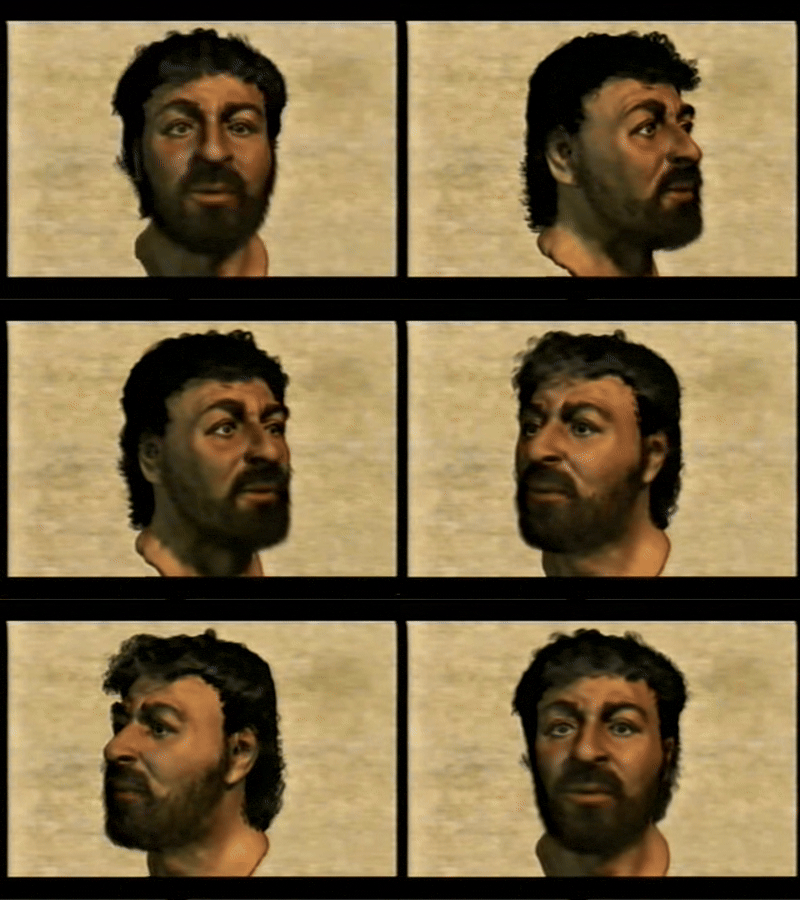
In 2001, the BBC aired a three-part documentary called Son of God. Forensic specialists attempted a facial reconstruction based on a first-century Jewish skull from the region. Richard Neave, a retired medical artist associated with the University of Manchester, helped create the final clay model. The documentary did not claim that this was the definitive face of Jesus. Instead, the reconstruction was intended to show what an ordinary Jewish man from that time and region might have looked like. The final result showed a man with darker olive-brown skin, dark hair, brown eyes, and a beard. Researchers also looked toward surviving images from the ancient world when considering likely hairstyles. This generally fits Paul’s comments to the Corinthians condemning men who wore long hair (1 Corinthians 11:14–15), although what Paul and his original audience considered “long” has been lost to time.
We may not know Jesus’ exact face. But historically, he probably looked much more like an ordinary first-century Jewish man from the Middle East than many later European paintings suggest.
The Shroud?
When conversations turn to Jesus' face, someone usually mentions the Shroud of Turin. The Shroud of Turin is a length of linen cloth bearing the faint front-and-back image of a crucified man. Some believe it to be the burial cloth of Jesus. The Shroud is kept in Turin, Italy. In 1898, photographer Secondo Pia photographed it and discovered that the photographic negative revealed the faint image with surprising clarity. Since then, the Shroud has been heavily debated. Whether it is an authentic ancient burial cloth connected to Jesus or a later creation remains highly contested.
One issue raised in discussions about the Shroud is that the man’s appearance can resemble later traditional European images of Christ more than modern reconstructions of an ordinary first-century Jewish man. Estimates of the man’s height also vary considerably depending on how the image is measured and interpreted. The man on the shroud is 5’ 7” to 6’ 2” tall, while the average size for first-century Jewish men was 5’1” to 5’5”. Because the Shroud remains so contested, it cannot give us a definitive answer about Jesus’ appearance.
In 2010, computer graphics artist Ray Downing created a reconstruction based on the image on the Shroud for the History Channel documentary The Real Face of Jesus? Downing’s Jesus has long dark hair, lighter olive skin, and an appearance much closer to traditional Christian art. But again, that reconstruction answers a different question. It shows us what the man on the Shroud might have looked like; not necessarily what the historical Jesus looked like.
His Clothes
While Jesus’ face remains a mystery, the Bible gives us more information about his clothing. John 19:23 mentions that while Jesus was on the cross, the soldiers divided his clothes and cast lots for his garment. It specifically mentions his tunic, or chiton. This was a basic garment worn against the body and commonly secured around the waist. Unlike many later artistic depictions of Jesus, ordinary men’s tunics were generally shorter than the long, flowing robes we often imagine. Since the world of Jesus had been deeply influenced by Greek culture before Roman occupation, clothing reflected the wider Greco-Roman world while also maintaining distinctly Jewish practices. For example, Jewish men were instructed to wear ritual tassels, or tzitzit, on the corners of their garments as reminders of God’s commandments.
In the story of the woman reaching for Jesus’ clothing in Mark 5, the garment can be understood as his outer cloak or himation. This was another piece of cloth wrapped around the body and could also carry the tassels associated with Jewish dress. When speaking about Jesus, John the Baptist says in Mark 1:7 that he is unworthy to “stoop down and untie the straps of his sandals.” Sandals were ordinary footwear, especially for people traveling long distances on foot as Jesus and his disciples regularly did. Jesus’ clothes were also likely made from the natural colors and materials common to ordinary people.
Lower-class and working people could not casually afford expensive dyes or elaborate embellishments. Clothing was valuable. People could repair, reuse, and pass down garments instead of throwing them away. An outer wool garment was especially important because it provided warmth during cold nights. Fabric was valuable, and clothing was practical. There was probably nothing particularly glamorous about what Jesus wore.
We often imagine Jesus as an unusually charismatic, perfectly groomed, well-dressed man who would immediately stand out in a crowd. But Jesus was a common person. Jesus, the Son of God and Messiah, primarily spoke everyday Aramaic slang. He lived under the shadow of Hellenistic cultural influence but, like most, struggled to speak the colonizer’s Greek. As a Jewish teacher who read and discussed Scripture in synagogues, he knew how to read Hebrew, although most didn’t.
The Light of the World wore common clothes, perhaps garments repaired and passed down through his family. The sandals John the Baptist claimed to be unworthy to untie were probably worn leather and nothing out of the ordinary.
The face that Christians would spend the next two thousand years painting, sculpting, debating, and imagining may have been a face that disappeared easily into a crowd. Maybe that is the point. When the Word became flesh, he became radically accessible. He did not arrive dressed according to the world’s standards of beauty, wealth, or status. His mission and words transformed so many hearts that the earliest Christians cared more about proclaiming who he was than preserving exactly what he looked like.
YouTube. (2009, December 4). Who Was Jesus? | National Geographic. YouTube. https://www.youtube.com/watch?v=EJF18yvTF6g&t=20s
Pruitt, S. (2026, March 23). What did Jesus look like?. History.com. https://www.history.com/articles/what-did-jesus-look-like
YouTube. (2009, December 4). Who Was Jesus? | National Geographic. YouTube. https://www.youtube.com/watch?v=EJF18yvTF6g&t=20s
Phillip, O. (2025, September 26). What Clothes Did Jesus Wear?. YouTube. https://www.youtube.com/watch?v=rurz4_Uhuo8