Lazarus Raised : “Resurrection and the Life”
“Then Jesus said, “Did I not tell you that if you believe, you will see the glory of God?” (John 11:40)
Reflection
One of the rules of any good fireworks show is simple: you save the best for last. The grand finale, the explosion of color and sound, is the moment the whole crowd has been waiting for. The Gospel of John is no different. His signs slowly escalate in scale and significance. In the beginning, Jesus turns water into wine. Near the end of his ministry, he raised a man from the dead. If the earlier signs were sparks, this one is the sky on fire. The story of Lazarus is dense with meaning, theology, and emotion. But for now, let’s notice three aspects of this miracle that reveal who Jesus is: apathy, empathy, and prophecy.
Apathy
Once again, Jesus subverts expectations. Lazarus, one of Jesus’ closest friends, is sick. His sisters, Mary and Martha, send a message: “Lord, the one you love is sick” (John 11:3). It feels like an easy miracle. Jesus has healed strangers from miles away with nothing but a sentence. Why hesitate now? But instead of rushing to Bethany, Jesus responds with a cryptic line: “When he heard this, Jesus said, 'This sickness will not end in death. No, it is for God’s glory so that God’s Son may be glorified through it.” (John 11:4)
Then, after John pointedly reminds us how much Jesus loves this family, Jesus waits two days. If you’ve ever prayed and felt like the Heavens were dragging their feet, you know this tension. God’s timing is perfect, but that doesn’t make the waiting painless. Mary and Martha don’t even ask Jesus to heal Lazarus. They simply inform him of the situation, trusting that Love will act. But Love delays. Jesus claims Lazarus’ sickness “will not end in death,” yet Lazarus dies. This may seem like a theological contradiction, but it reveals Jesus’ perspective. As with other signs in John’s Gospel, Jesus operates with a different sense of time. He speaks from where the story is going, not where it currently is. When Jesus is told the news, he sees resurrection at the end of the chapter. Sometimes God delays, not because he is unmoved by our suffering, but because he wants to heal the whole problem and not just the symptom.
Faith can feel like being an astronaut, exploring heights we didn’t know existed. Other times it can feel like being a scuba diver, descending into depths where light doesn’t reach. Both are forms of discovery. Both are forms of courage revealing the same truth: we are not meant to fear the unknown. God wants to develop us as much as he wants to deliver us.
Empathy
The passage culminates in resurrection, but most of the story takes place at a funeral because most of life is lived here. When Jesus finally arrives, Lazarus has been dead for four days. Mary and Martha are “sitting shiva”, a traditional Jewish practice of intense mourning of a loved one lasting seven days. Family and friends are gathered around them for comfort during this time. But Jesus interrupts the tradition.
Jesus hasn’t even entered the town before Martha comes to meet him, instead, in half-lament, half-hope:
“Lord, if you had been here, my brother would not have died… But I know even now God will give you whatever you ask.” (John 11:21–22) This is astounding faith. Jewish tradition held that the soul lingered near the body for three days, but after four days, all hope was gone. There was no reason for Martha to hope, but a small part of her faith holds on. God cannot heal what we refuse to name. John’s Gospel constantly shows the tension between human limitation and divine possibility: Mary at Cana (John 2:4), the invalid at Bethesda (John 5:6-7), or the crowds after the feeding (John 6:25-59). Jesus reveals who he is, and people struggle with what that means. Yet through it all, Jesus has compassion.
“When Mary reached the place where Jesus was and saw him, she fell at his feet and said, “Lord, if you had been here, my brother would not have died.”…“Where have you laid him?” he asked. “Come and see, Lord,” they replied. Jesus wept. (John 11:32,34-35).
If Jesus knows he’s about to raise Lazarus from the dead, why cry? Because God is not a manager or a mechanic. He doesn’t just fix problems; he shares pain. Makoto Fujimura once wrote that Christ’s tears prove we serve a God of abundance: God is not efficient. God, who exists outside of time, steps into time to mourn with us. Resurrection is not a cold rule of divinity. It’s the overflow of comfort and security.
Prophecy
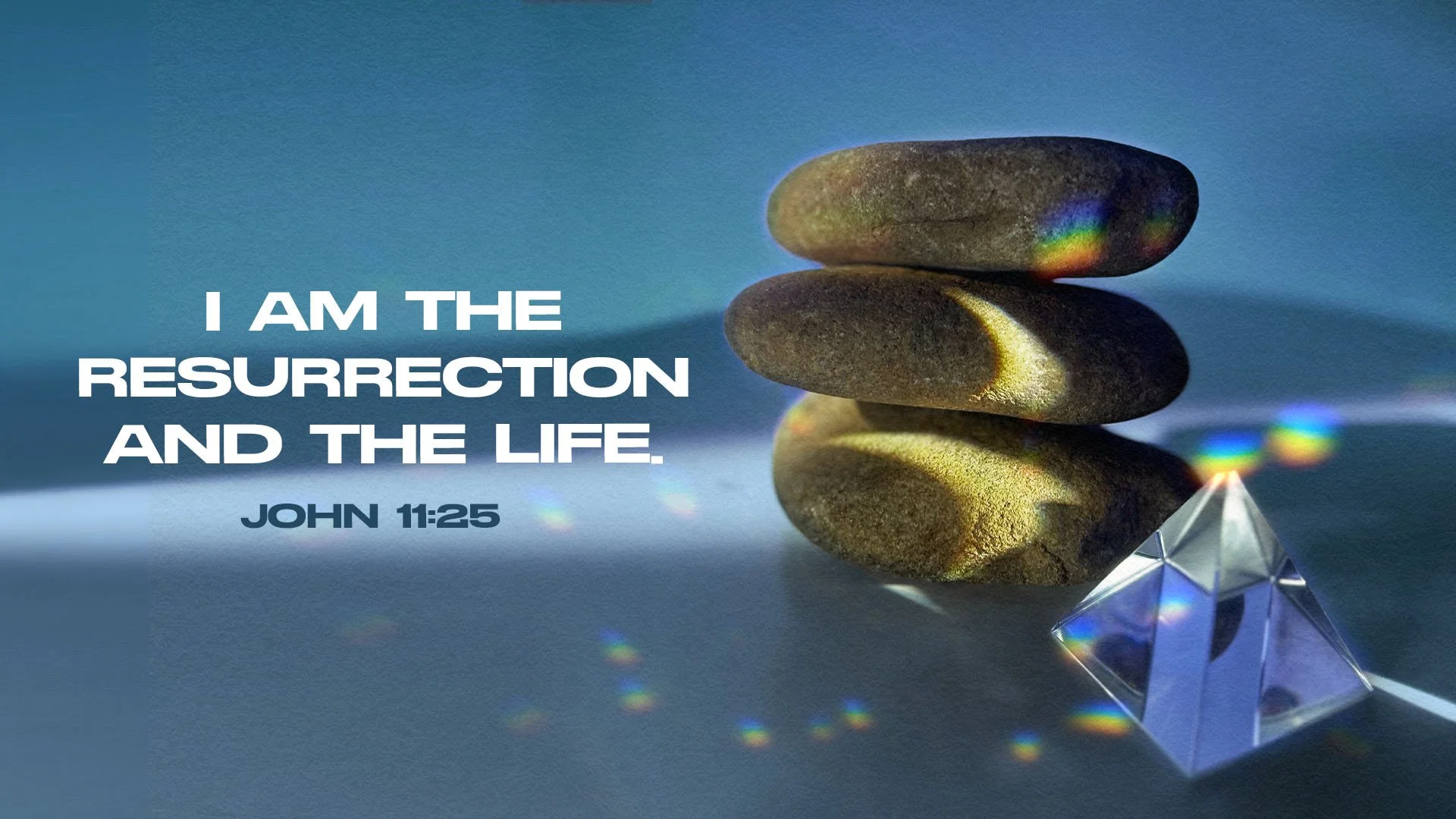
Martha voices her theology in John 11:24, that the dead will rise again on the last day. Jesus doesn’t correct her, but he shifts the frame: “Jesus said to her, 'I am the resurrection and the life. The one who believes in me will live, even though they die; and whoever lives by believing in me will never die. Do you believe this?”(John 11:25-26). Many Jews believed in a final resurrection. Other Jewish groups, like the Sadducees, did not. In the mixed crowd at the funeral, opinions on what this miracle meant probably varied. But whatever they believed about resurrection, they were forced to make sense of Jesus after they saw what happened. If Lazarus rose now, was this the Last Day? Or the first sign of a new age? Or proof that Jesus was staging the scene for credibility? Whatever conclusion they reached, everything started to revolve around Jesus.
Jesus tells Martha plainly who he is: “I am the Resurrection and the Life.” John began his Gospel with the same claim in different language: “In him was life, and that life was the light of all mankind” (John 1:4). Jesus is not merely someone who accomplishes resurrection; he embodies it. To believe in him is not to recite a creed but to trust the Life he carries into the graves of this world. Think of holding a candle in a cave. Your confidence is in its light. Every step forward is guided not by certainty of the path, but by faith that the flame will reveal enough to keep moving. That is what Jesus means when he says resurrection is not just a future moment, but a present reality. When Jesus calls into the darkness of the tomb, Lazarus walks out to prove it.
Take With You
“Therefore many of the Jews who had come to visit Mary, and had seen what Jesus did, believed in him. But some of them went to the Pharisees and told them what Jesus had done…. So from that day on they plotted to take his life.” (John 11:45-46, 53)
In a moment of irony, the resurrection of Lazarus becomes the catalyst for Jesus's death. Life for one man sets in motion a plot that takes another's life. This sign marks the hinge of John’s Gospel, the moment we move from the Book of Signs into the Book of Glory.
Scholars have long wondered why John is the only Gospel writer to record such a stunning miracle. In 1831, commentator Adam Clarke noted Grotius’ conjecture that the three earlier Gospel writers may have avoided mentioning Lazarus while he was still alive, fearing that such attention might endanger him. Others argue that Matthew, Mark, and Luke draw heavily from shared sources, likely shaped by Peter’s preaching, and that Peter may not have been present for the event. Whatever the historical reason, the literary purpose in John is unmistakable.
John writes his Gospel to reveal Jesus as the Creator who has come to dwell with creation. His memories are curated, his pacing deliberate, his signs arranged to show not only what Jesus can do but also who Jesus is. The Synoptic Gospels make their own arguments about identity, and they too include resurrection stories: Jairus’ daughter (Matt 9; Mark 5; Luke 8) and the widow’s son in Nain (Luke 7). Jesus raises the dead in all four Gospels. But John pushes the argument further. He doesn’t just claim that Jesus performs resurrection. He claims Jesus is Resurrection.
John admits at the end of his Gospel that Jesus did “many other things” not recorded in any book. What we do have is selected for the purpose of strengthening belief and reshaping imagination. Lazarus’ resurrection is a preview. It’s a foreshadowing of what’s coming for Jesus and ultimately for us. If Jesus can confidently call another out of death, then we can trust him when he walks into the darker tombs of our world and our lives to call us out. His own triumph over death is a finale to admire and a reason to follow.
Clarke, Adam. “John 11.” John 11 Clarke’s Commentary, Internet Sacred Texts Archive, 1831, biblehub.com/commentaries/clarke/john/11.htm.
Guzik, David. “Enduring Word Bible Commentary John Chapter 11.” Enduring Word, The Enduring Word Bible Commentary, 11 Feb. 2025, enduringword.com/bible-commentary/john-11/.
Fujimura, Makoto. Art and Faith: A Theology of Making. Yale University Press, 2025.