9. Tough Talks
Today’s Reading: Mark 10:1-31
On Marriage (v. 1–12)
The key to interpreting this tricky passage lies in three places.
1. The Religious Leaders’ Test
The passage seems controversial because it is, but not in the ways you might think. The crowds are surrounding Jesus as he teaches, and the religious leaders see this as an opportunity to “test” him. Rabbis often publicly debated the Law. This Jewish practice could be a helpful format for teaching and gaining a deeper understanding of Scripture. However, the religious leaders are not seeking understanding. They are trying to trap Jesus. So, they choose one of the most controversial topics of the time and force Jesus to choose a side: “Is it lawful for a man to divorce his wife?” (Mark 10:2).
2. The Historical Context of the Debate
This question may not seem as controversial today, but at the time it was closer to asking Jesus about abortion or what political party he belonged to. There were two major schools of thought on divorce.
One came from the popular rabbi Hillel, who taught that if a wife displeased her husband in almost any way, he could divorce her. Bad cooking, infertility, or even an unfavorable opinion could become reasons for divorce.
Another school, associated with Rabbi Shammai, taught that divorce should be limited to much more serious circumstances. These circumstances were defined more narrowly and were harder to justify. Jesus would be forced to choose a side in a popular debate and potentially alienate people in the crowd.
3. What Jesus Says Publicly vs. Privately
In verse 3, Jesus asks them what Moses would say. He does this because they are teachers of the Law. He brings them back to the words of the Torah. Similar to his testing in the wilderness, Jesus responds with Scripture. “For this reason a man will leave his father and mother and be united to his wife, and the two will become one flesh” (Mark 10:7–8). But the passage Jesus uses is even more foundational than Moses. He goes back to creation. It is almost as if Jesus is saying, “You are concerned with Moses and the rules, but I am concerned with how you were made.”
Jesus begins his public response in verse 5 by saying that Moses permitted divorce because human hearts are hard. The phrase “hard hearts” recalls Pharaoh’s response to Moses’ request to free the enslaved people in Exodus. In the covenant of marriage, God offers a small experience of what it means to “become one,” as all things will one day be united in God. But because human beings can be cruel and sinful, there is also a way out of that covenant.
Jesus is not shaming people who have been divorced. This passage is not about staying in abusive relationships. It is not about people who sincerely tried to work through a relationship and still separated. It is not about leaving because clarity finally came. This passage is also not about the LGBTQ+ community. This passage is about making an oath or covenant and abandoning it because of a lack of perseverance.
Suffering is not beneath the human experience. Quite progressively, Jesus is also considering the woman’s situation. In this patriarchal society, a divorced woman could be seen as disgraceful or as “damaged goods.” She often carried the social and economic consequences of a man’s decision.
When Jesus addresses his disciples privately, he says, “Anyone who divorces his wife and marries another woman commits adultery against her” (Mark 10:11). In the context of the larger principle, Jesus is saying that you cannot leave one commitment simply because effort is required and then expect the next commitment to solve the problem. You can carry the same dysfunction into the next relationship without ever confronting yourself. Again, this is not about abusive relationships or relationships where people genuinely tried, and it still did not work. The larger principle is that your covenant matters. Your oaths have power. You do not get to give up simply because you become uncomfortable. You work through difficulty with your partner through understanding, honesty, and grace. This is part of the process of becoming one.
On Money (v. 17–31)
Similar to the debate on divorce, the story of the rich young ruler illustrates the same principle of commitment. A rich man approaches Jesus and asks how he can inherit eternal life. The rich man is searching for quantity, while Jesus is speaking about quality. In verses 18–19, similar to verse 5, Jesus points toward the human struggle with goodness. By asking the rich man about following the Law, Jesus plays on his assumption that salvation comes through “being good.”
“Teacher,” he declared, “all these I have kept since I was a boy” (Mark 10:20).
Then comes one of the most important details in the story:
“Jesus looked at him and loved him. “One thing you lack,” he said. “Go, sell everything you have and give to the poor, and you will have treasure in heaven. Then come, follow me” (Mark 10:21).
Jesus switches the criteria from outward appearance (quantity) to the inward condition of the heart (quality). This reveals that the rich man’s deepest commitment was not actually to eternal life. His commitment was to performance and to the wealth that served him. When something difficult was asked of him, he divorced the idea of eternal life. Many have mistaken Jesus’ words here as a universal command for everyone seeking salvation. But Jesus’ words are directed toward this particular rich man, whose heart he could see.
Mark records Jesus’ words about wealth for a Gentile community where early Christians were learning to share their resources. The later story in Acts 5 about Ananias and Sapphira offers a similar cautionary tale about holding back while pretending to be fully committed. The principle is this: those who are committed to following Jesus, whatever it costs them, will be rewarded in the world to come. Or, as Kanye West put it in “Keep My Spirit Alive” (2021): “Give it all to God and let Jesus reimburse you.”
On Children (v. 13–16)
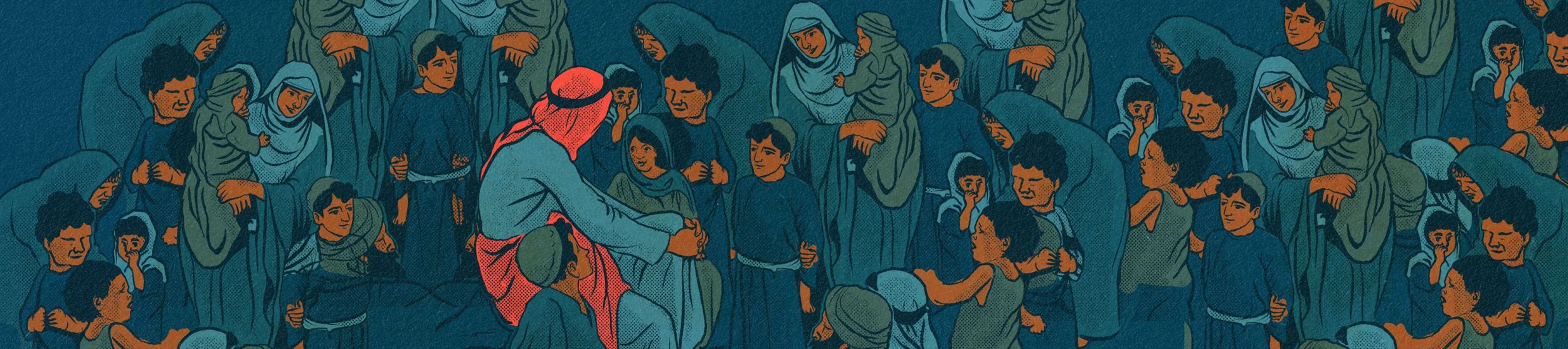
Sandwiched between these two heavy conversations, Jesus is greeted by parents bringing their children to be blessed by him. The disciples try to stop them, but Jesus becomes angry.
“Let the little children come to me, and do not hinder them, for the kingdom of God belongs to such as these. Truly I tell you, anyone who will not receive the kingdom of God like a little child will never enter it” (Mark 10:14–15).
Where Jesus upholds the value of women in his words about divorce, here he upholds the value of children. Children had very little social power in the ancient world. Like women, they occupied a vulnerable position and were often valued primarily for what they would become rather than for who they already were. With these words, Jesus recognizes the wonder and special vantage point children have on the world. Children receive, trust, and wonder. Unless we learn to walk through the world with that kind of openness, we can miss the reign of God happening all around us.
Reflection Questions
Jesus’ teaching on marriage points toward the importance of covenant and commitment. Where in your life are you tempted to give up simply because something has become difficult?
The rich young ruler wanted eternal life, but struggled when following Jesus threatened what he valued most. What would be hardest for you to surrender if Jesus asked for it?
Jesus says the Kingdom of God must be received like a child. What would it look like for you to practice more trust, openness, and wonder in your relationship with God?