4. Growth Track
Today’s Readings: Mark 4-5:20
Soil Samples (v. 1–34)
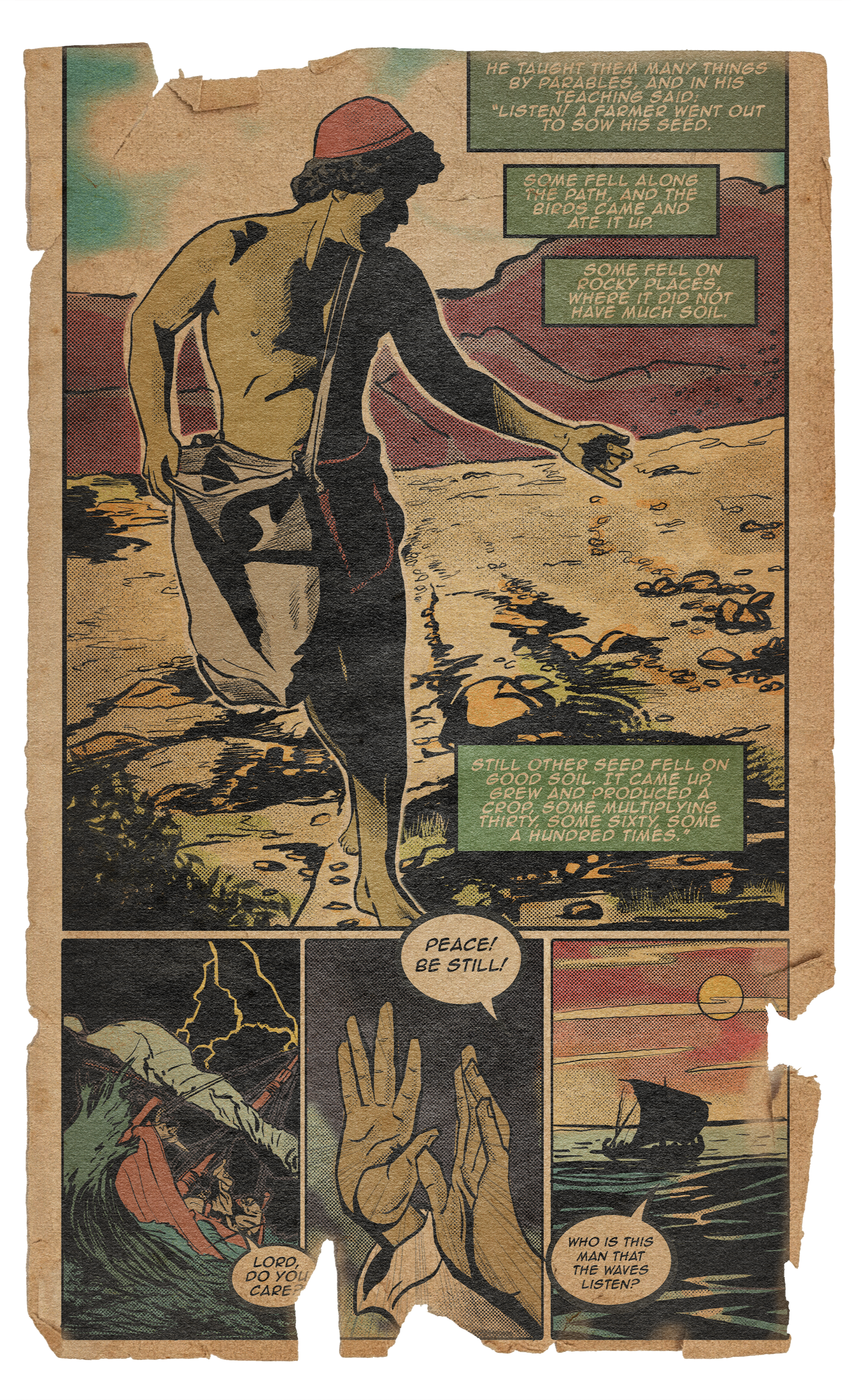
Jesus knew that a certain type of internal environment needed to be created for the message to be received. In the parable of the Sower, he describes the different environments his word will land in. The seed representing the word of God is absolute. It is the soil’s job to create an environment conducive to the seed's growth.
The first type of soil is along the path, where birds eat the seed almost immediately. Later, in verse 15, Jesus explains that this represents how Satan can come and take away the word when it is sown. Insecurity can deter us from receiving the Word of God. Sometimes there is a gap between what God says and what we see. A seed doesn’t grow if it just sits on the surface. It has to be buried deep.
The next group of seeds falls on rocky places. They grow quickly but are scorched by the sun. The appearance of growth isn’t always a great indicator of the depth of growth. Enthusiasm is only as good as its application.
With the seeds that fall among the thorns, Jesus is describing those who hear the word and resonate with it. In fact, roots grow deep, and it is evident that they are really practicing what was said. But the thorns (concerns, worries, and other desires) slowly choke out the word that was spoken.
Of course, the last type is good soil that produces a harvest. But this parable isn’t meant to shame people. It is a mirror meant to help us analyze the different ways we receive God’s word.
Wind, Waves, and Possessed Pigs (4:35–5:20)
In this familiar story, Jesus tells his disciples they will travel by boat to the other side of the Sea of Galilee. A great windstorm erupts as they cross and nearly sinks the boat. But Jesus is found sleeping peacefully in the stern. This image can be contrasted with Jonah 1:5, where the prophet also sleeps during a storm. In Jonah’s case, however, he is trying to run away from God. Where Jonah slept in disobedience to God, Jesus sleeps to show that his words, “Let us go over to the other side” (v. 35), are true.
The disciples call upon Jesus, who would have been soaked and was still sleeping. He wakes up and rebukes the wind and the waves. Immediately, everything is calm. The disciples stand shocked and say, “Who is this? Even the wind and the waves obey him!” (v. 41).That question—Who is this?—is an important theme that connects us to the next story.
The disciples are still confused about the identity of Jesus. Yet they follow him as the boat docks in “the region of the Gerasenes,” which is Gentile territory. As Jesus makes his way onto the shore, a demon-possessed man rushes toward him. This man cries out among the graves (lives near dead bodies), cuts himself (bleeds), and cannot be held by chains. Notice how this description paints the possessed man as extremely unclean to a Jewish person—not to mention the Gentile region they are already in.
For the Gentile audience of this Gospel, this shows a Jesus who has come for them as well. In fact, this unclean, possessed man recognizes Jesus’ identity; something Jesus’ own disciples are still confused about.
The name the possessed man gives in verse 9 isn’t really a name at all: “Legion.”
“Legion” can have a layered meaning because it was a term used to describe a large group. Legion could refer to the number of evil spirits possessing the man. But Legion could also be a reference to Roman military forces stationed in the region. This possibility becomes even more interesting in the next few verses, where Mark mentions a nearby herd of 2,000 pigs. The miracle can take on a political angle. Jesus isn’t simply performing another exorcism. He may also be creating a familiar picture for his Jewish followers.
Remember, many Jews expected the Messiah to come for Israel and drive out their enemies. During the Exodus, another powerful “legion” was drowned in the sea. Those were a legion of Egyptian soldiers and chariots. Now, Jesus commands the demons to enter the pigs. The herd rushes over the steep bank and is swallowed by the sea. Jesus is making a claim about his identity as Israel’s God, the one with the power to deliver.
But there is an important difference. Jesus has gone out of his way into Gentile territory to deliver an unclean man plagued by demons. Jesus didn’t come to drive out Israel’s enemies in judgment like during the Exodus. He came to bring restoration and healing.
When the townspeople and pig farmers see what happened and see the formerly possessed man healed, they ask Jesus to leave. Pigs were profitable livestock in non-Jewish areas, so the loss of the herd would have been felt economically. But their profit seems to be more of a concern than a person’s healing. Jesus then tells the healed man to go and spread the news about “how much the Lord has done for you” (v. 19). This stands out because Jesus has repeatedly discouraged people from spreading news about his miracles. But here, he encourages it. He is in Gentile territory, away from the religious authorities who have been trying to interfere with his ministry.
Reflection Questions
Jesus tells the parable of the different soils to illustrate the different ways we can receive God’s word. How do you relate to each one?
In this section of parables, Jesus uses a lot of farming metaphors to talk about the Kingdom of God. Why do you think that is? What makes these images so powerful?
Jesus displays his power over wind, waves, and unclean spirits. How have you experienced Jesus’ power in your own life?