“…with Me in Paradise.”
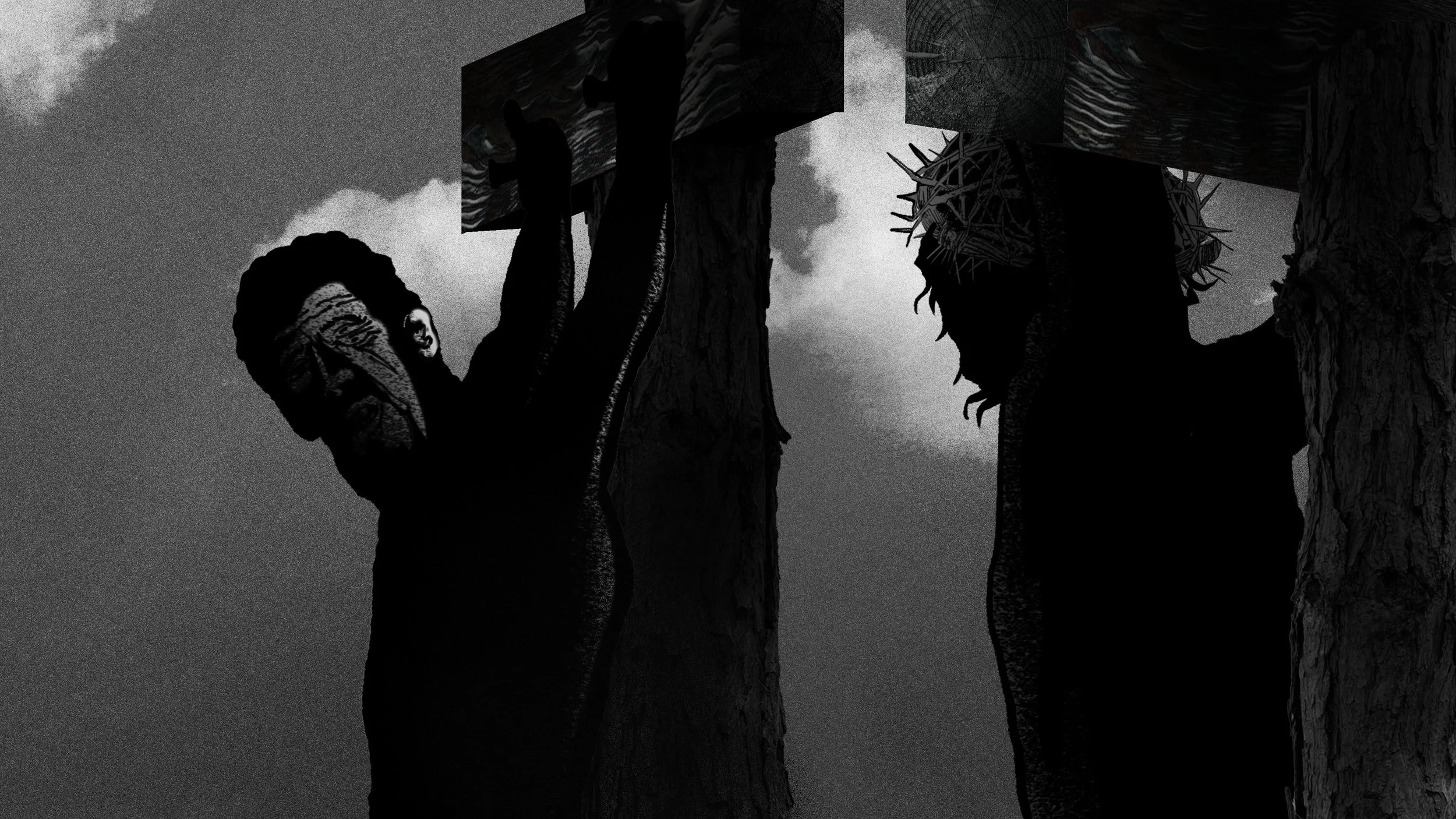
Jesus answered him, “Truly I tell you, today you will be with me in paradise.” (Luke 23:43)
Have you ever heard that old Acapella song from 1988?
“When they crucified the ever-loving, caring Master
with compassion flowing from His eyes,
He said to a thief who was begging Him for mercy,
"Today you'll live in Paradise."
I'm saved, I'm saved, I'm saved like the criminal on the cross...”
(Performed by Acapella, 1988)
It captures a sentiment you hear all the time in Christianity, the idea that the most important thing about the criminal on the cross next to Jesus is that he made it into Heaven at the last possible second. Honestly, that’s understandable. Death is unknown territory. Who wouldn’t cling to a moment in Scripture that gives a glimpse of what comes next? Across church history, Jesus’ words—“Today you will be with me in paradise”—have launched entire debates. Why was his lack of baptism not a hindrance for Salvation? After a life of crime, was it last-minute faith that got him into the pearly gates? Greek and Hebrew scholars will say that ancient languages lacked punctuation, so it’s unclear whether Jesus is promising paradise now or later (“Truly I tell you today, you will…” vs. “Truly I tell you, today you will...”).
But buried beneath all those arguments is a far more compelling story. It has less to do with Heaven and everything to do with a man hanging on a cross beside Jesus, trying to make sense of the final moments of his life.
Rebel With a Cause
All four Gospels mention the two criminals crucified with Jesus, but only Luke gives us a conversation. Matthew and Mark say both criminals hurled insults. So, something changed in at least one of them. To understand that shift, you have to look at the world this man lived in. During the time of Jesus, Rome was in a period known as the Pax Romana, or Roman Peace. It’s a period marked by Empire expansion and technical advancement. For the people they conquered, it meant military presence, heavy taxes, and constant reminders of who was in charge. That environment produced the Zealots: underground resistance fighters trained to strike back. Rebels. Freedom fighters. Terrorists, depending on who told the story.
The Greek word used for the men executed with Jesus is “rebels.” This man wasn’t a petty thief. He was probably a Zealot. Picture his life: his homeland occupied, his faith threatened, his family living under a foreign military. In that world, resistance felt righteous and even necessary, even if it wasn’t God’s way. Maybe the only honorable thing left. We don’t get his backstory, but we do know where his life’s choices led him: dragging a crossbeam and yoked to two other men being led out to die. We don’t know if he knew anything about Jesus before, but he did hear what the crowd was saying:
“He saved others; let him save himself if he is God’s Messiah, the Chosen One!” (Luke 23:35)
“If you are the King of the Jews, save yourself!” (Luke 23:37)
“Ah, this must have been one of those failed messiahs,” this man might have thought to himself as they arrived at Golgotha’s hill. Crucifixions happened regularly, and people often saw them. The cross was a sign that you had lost; whatever revolution you started was squashed by the Empire. So the rebels’ first impression of Jesus is not as Savior, but as a failure. And honestly? That sounds like a lot of people today.
People who only ever met a distorted Jesus. Harsh rule-keeper Jesus. Judgmental family Jesus. Abusive power-play Jesus. A failure or, at the very least, not who he says he is.
The Shift
The Gospels don’t agree on the order of Jesus’ final words, so we don’t know what the criminal witnessed first. We only know this: He began the morning insulting Jesus, as everyone else did (Matthew 26:44, Mark 15:32). Maybe he joined in to disguise his own fear. Maybe he mocked Jesus to distract from his own crucified humiliation. Maybe he simply believed the crowd. But somewhere between the nails and the afternoon shadows, something changed.
“One of the criminals who hung there hurled insults at him: 'Aren’t you the Messiah? Save yourself and us!” But the other criminal rebuked him. “Don’t you fear God,” he said, “since you are under the same sentence? We are punished justly, for we are getting what our deeds deserve. But this man has done nothing wrong.” (Luke 23:39-41)
What did he see? This man recognizes that something holy is happening on the cross beside him. Maybe it was Jesus praying for the very soldiers torturing him. Maybe it was Jesus caring for his mother from the cross. Maybe it was the silence of Jesus in the face of the mob's hatred. Whatever it was, this rebel suddenly realized: “He’s innocent. And I’m not.” What if a moment in Jesus’ actual presence could do the same for people who only met him through church hurt or hypocrisy? That abuse and atrocity in God’s name wasn’t the real Jesus. Religious legalism and cultural shame weren’t the real Jesus, just a human ego wearing his name. Maybe, like this criminal, one glimpse of the real thing could show you his innocence.
Then comes the most astonishing part: “Then he said, 'Jesus, remember me when you come into your kingdom.” (Luke 23:42) Think about how wild that is. All three men are being publicly humiliated, bleeding, gasping for air, and moments from death, yet the man’s realization goes further. No army. No throne. No kingdom in sight. Yet this rebel believes that Jesus is a king. And not just any king. A king with power, who will outlive the grave, and remember him beyond death. This criminal doesn’t have theology, know all the creeds, or can explain atonement or incarnation. He simply recognizes he is in the presence of a king.
Rest For The Soul
“Jesus answered him, “Truly I tell you today you will be with me in paradise.” (Luke 23:43)
For the first time in his life, the rebel can rest. The worst day of his existence becomes the moment he finally meets someone who sees him, not as a failed revolutionary or as a cautionary tale, but as a man worth remembering. His last breath is a sigh of relief.
Are we changed like that when we encounter Jesus? Or have we grown numb and familiar with him? This story is not simply about a ticket to Heaven. It is an invitation to meet the innocent Jesus, the one not ruined by bad religion, not distorted by abusive power, not wrapped in shame and rules. It is an invitation to let him remember you. To let him redefine your failures and speak rest into the worst parts of your story. This rebel wasn’t saved because he understood everything. He was saved because, in the last moments of his life, he finally saw Jesus for who he really is. That is where transformation always begins.