12. The Temple Talks
Today’s Reading: Mark 11:27-12:44
Whose Authority? (Mark 11:27–12:12)
In this section of Scripture, Mark records Jesus’ last visit to the Temple and his final public teaching before his death. It begins with the religious leaders confronting Jesus in public. They are trying to trap him with a series of difficult theological questions. The first question they ask is, “By what authority are you doing these things?” they asked. “And who gave you authority to do this?” (Mark 11:28). Jesus responds by asking them about John the Baptist. John had been a controversial figure for the religious elite because he consistently called them out. After the religious leaders fail to answer, Jesus begins to tell a difficult parable.
The parable goes like this: a man builds an extravagant vineyard. It is so large that he hires workers to care for the land while he is away. When harvest time comes, the owner sends servants to collect what belongs to him. But the workers, who have become attached to the land, decide to beat or kill each messenger in order to take control of it. Finally, the vineyard owner sends his son. But the workers decide to kill him too, believing this will allow them to receive the inheritance of the land. At this, Jesus says the vineyard owner will have no option but to destroy the workers and find new ones.
Through this story, Jesus is foretelling his death at the hands of his own people and their corrupt religious and political systems. The mention of a vineyard is important. A vineyard is a common metaphor for Israel, as seen in Isaiah 5:1–7. The workers represent those in charge of protecting Israel, especially the religious leaders such as the Pharisees and Sadducees. The servants sent to collect the harvest represent the prophets. Of course, the vineyard owner’s son is Jesus.
This whole interaction began with a question about authority. In the story, ownership and authority over the land have become confused in the minds of the vineyard workers. Their job was to work the land and collect the harvest for the owner. But their labor created a sense of entitlement and attachment. The owner became a distant memory. Throughout Mark’s Gospel, the religious leaders have constantly criticized Jesus and his disciples for not obeying the Jewish Law. But Jesus was not actually breaking the Law of Moses. He was often breaking the additional laws and traditions that had been built around it. The religious leaders had become zealous, not simply for enforcing God’s Law, but for enforcing man-made traditions.
But the point of Jesus’ parable can be found in the very first line: “A man planted a vineyard. He put a wall around it, dug a pit for the winepress and built a watchtower” (Mark 12:1).
The vineyard did not start with the workers. Jesus is telling the religious leaders: God was at work before you even got here. The parable ends with the vineyard workers being destroyed and new ones taking their place. It is significant that this story is included in Mark’s Gospel because Mark was written largely for Gentile communities. They are the “new vineyard workers”. Through Jesus, Gentiles are now being welcomed into the covenant family of God.
What Truly Matters (Mark 12:13–37)
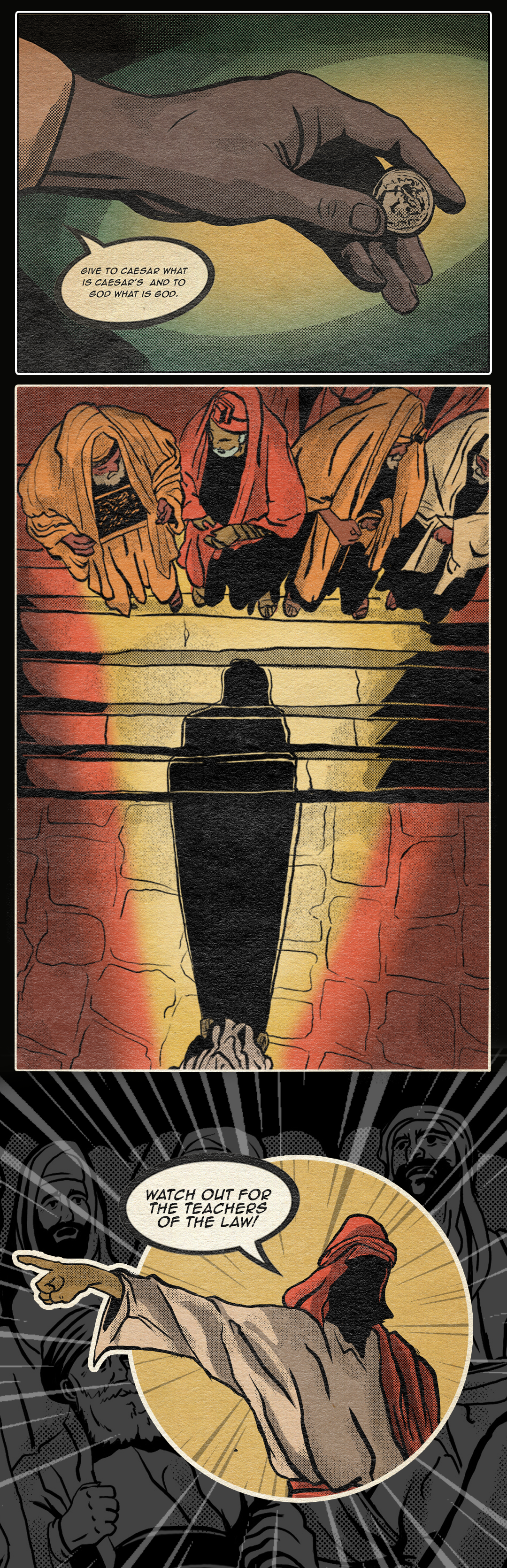
The bulk of Jesus’ Temple showdown with the religious leaders centers around the question: what truly matters? For example, the religious leaders ask, “Is it right to pay the imperial tax to Caesar or not?” (Mark 12:14). Although they are asking this question to trap Jesus, the concern itself was a real one for the people gathered in the Temple. Roman coins carried the image of Caesar and his title as god. For many Jewish people, this created tension because those images and titles could be seen as idolatrous or blasphemous.
“Then Jesus said to them, ‘Give back to Caesar what is Caesar’s and to God what is God’s’” (Mark 12:17).
Jesus’ point is that Caesar may have authority over his coins, but he cannot have you if you belong to God. Later, in John 18:36, Jesus says, “My kingdom is not of this world.” God’s reign does not need to be stamped onto coins for it to be real. It is a deeper reality of the heart.
Then, a religious sect known as the Sadducees approaches Jesus with another question. The Sadducees did not believe in resurrection, yet they ask Jesus a question about resurrection. It almost feels like Mark is winking at the audience, showing how performative these questions have become. They create a long hypothetical about a woman who repeatedly becomes a widow. Their question is: whose wife will she be at the resurrection? But Jesus cuts straight to the heart of the problem.
“Jesus replied, ‘Are you not in error because you do not know the Scriptures or the power of God? When the dead rise, they will neither marry nor be given in marriage; they will be like the angels in heaven’” (Mark 12:24–25). Jesus points out that their denial of resurrection limits their understanding of God. God is a living God. If death can permanently overpower even God, then God is not all-powerful.
Then, right at the most tense moment, a religious leader asks Jesus a genuine question: “Of all the commandments, which is the most important?” (Mark 12:28). After all the hypotheticals and trick questions, someone finally asks: What truly matters?
“The most important one,” answered Jesus, “is this: ‘Hear, O Israel: The Lord our God, the Lord is one. Love the Lord your God with all your heart and with all your soul and with all your mind and with all your strength.’ The second is this: ‘Love your neighbor as yourself.’ There is no commandment greater than these” (Mark 12:29–31).
The heart of God’s Law is loving God and loving others. For the Gentile audiences reading Mark’s Gospel, this long theological debate between Jesus and the religious leaders may have felt difficult to follow. They were outsiders to many Jewish laws and traditions. But Jesus simplifies the whole Law into two focuses: Love God. Love people.
A Lesson in Giving (Mark 12:38–44)
Jesus leaves the place where he was being questioned and sits down near the Temple treasury. The offering receptacles in the Temple were shaped somewhat like trumpets, with wide openings that narrowed below. This allowed money to be deposited while making it difficult for someone to reach inside and take it out. The story tells us that many wealthy people put in large amounts. It’s like they were tooting their own horns. But then a poor widow puts in two small copper coins. “Calling his disciples to him, Jesus said, ‘Truly I tell you, this poor widow has put more into the treasury than all the others. They all gave out of their wealth; but she, out of her poverty, put in everything—all she had to live on’” (Mark 12:43–44).
Many people read this story as an example of generous giving to the mission of God. The lesson becomes that it is more virtuous to give sacrificially than to give boastfully. But Jesus’ words immediately before this scene paint a different picture. Before he sits near the offering treasury, Jesus ends his public teaching with a bold statement about the religious leaders. It is a shortened version of a longer rebuke found in Matthew 23. He says in verse 40, “They devour widows’ houses and for a show make lengthy prayers” (Mark 12:40).
Jesus is warning about the hypocrisy of the religious leaders. They work in God’s house and are supposed to be charitable. They are supposed to “love their neighbor as themselves.” They are supposed to protect the widow and the orphan—two groups in ancient society who were especially vulnerable and often lacked access to wealth or protection. But immediately after this rebuke, Jesus watches a widow give everything she has to the very system that should have been caring for her. The Temple should have been providing for her. Instead, it is taking from her. The story of the widow’s offering can be read as a cautionary tale about what happens when religion receives more than it gives.
Reflection Questions
The religious leaders were so attached to their understanding of authority that they struggled to recognize what God was doing in front of them. Where might your own expectations make it difficult to recognize God at work?
Jesus simplifies the heart of the Law into loving God and loving others. Which of those two areas feels easier for you right now? Which feels more difficult?
The story of the widow raises questions about religious systems and responsibility. How can we make sure our faith communities care for vulnerable people rather than placing heavier burdens on them?