6. Feasts and Frets
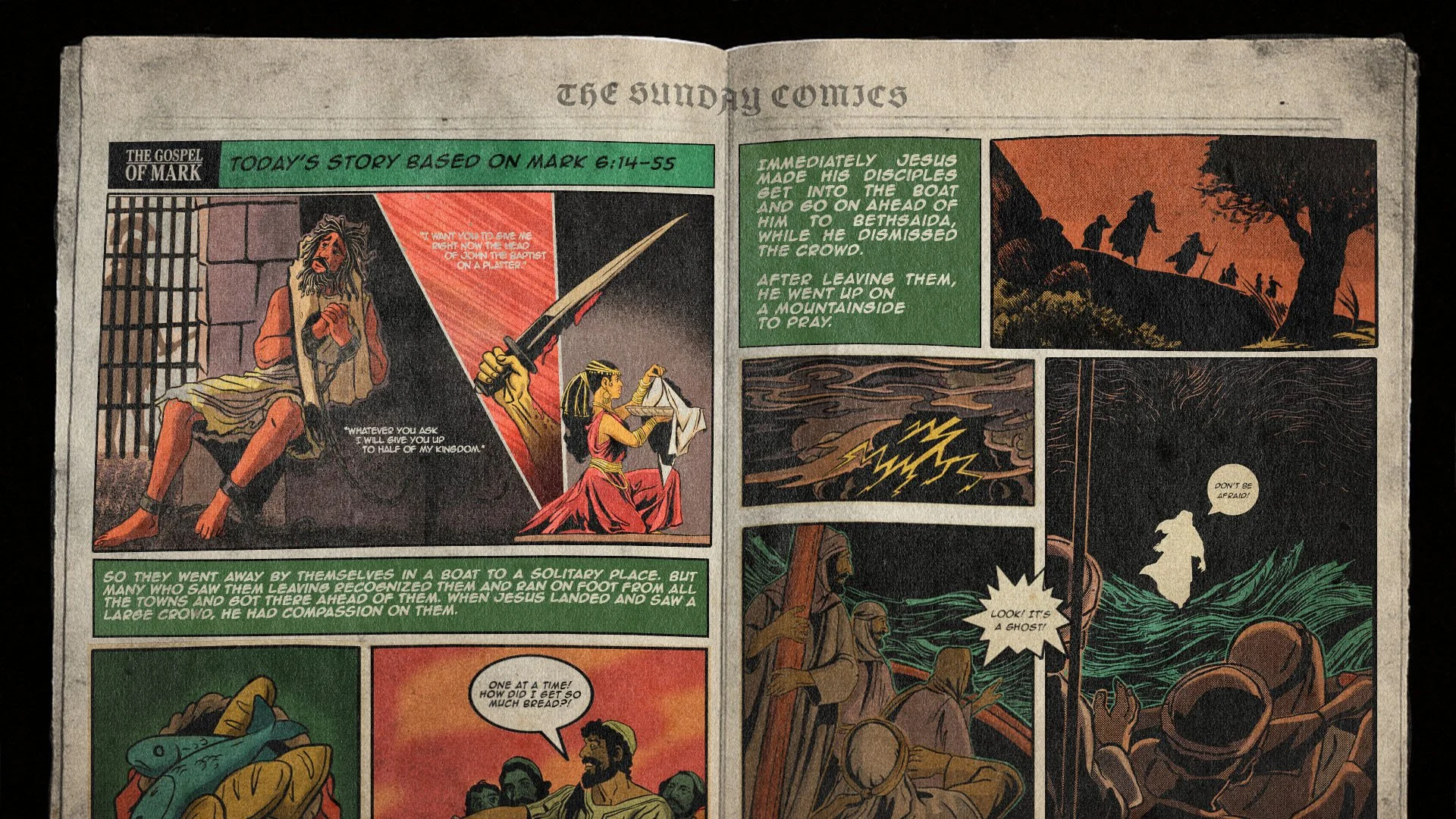
Today’s Reading: Mark 6:14-56, 8:1-21
Party Penalty (Mark 6:14–29)
This episode opens on a disgruntled King Herod hearing the news of Jesus’ popularity. We see Herod’s worry that John the Baptist has come back from the dead—cue flashback!
John the Baptist had been arrested for speaking out against King Herod’s marriage to his brother’s wife, which under Jewish Law was considered unlawful. The “King Herod” in this story is the son of the Herod in the Christmas story in Matthew 2. He and his father were both put in power under Roman authority as representatives over the Jewish people. Thus, he was more of a puppet king. Herod’s new wife, Herodias (I know, really obsessed with the family name), was plotting to have John killed.
At Herod’s birthday feast, his stepdaughter seductively dances for him and the guests. The scene may echo King Xerxes' request in Esther 1:10–11, where a king’s banquet, desire, and public image collide. Herod is so aroused by his stepdaughter’s dance that he offers her “whatever [she] asks…up to half my kingdom” (v. 23). Herodias instructs the girl to request the head of John the Baptist on a platter. Not wanting to appear weak in front of his guests—a foreshadowing of Pilate—Herod orders John the Baptist to be executed.
At this feast, the only thing served was a decapitated truth. King Herod, who sat on a throne of lies and a multitude of sins, sacrificed the truth when it threatened his image. Contrast that with a miracle Jesus performs twice in Mark: the feeding of the multitudes. When the real King serves his people, they go home full and with leftovers. Evil will serve truth distorted, while goodness will offer truth that sustains.
Forgetting the Feed (Mark 6:30–44; 8:1–21)
Jesus feeds the multitudes with a seemingly impossible amount of food twice. Both accounts follow the same pattern. Jesus is preaching and healing in a remote place, and it gets late. The disciples approach Jesus and tell him that the people should head home so they can find food. But Jesus tells them to feed the crowd. The disciples scrounge up what they can find: a small number of loaves and, in one case, some fish. Jesus blesses the food and breaks it into pieces. The bread and fish seem to continue breaking into pieces—enough to feed the large crowd and leave substantial leftovers.
But notice the response after the second time this happens in Mark 8:11–12: “The Pharisees came and began to question Jesus. To test him, they asked him for a sign from heaven… He sighed deeply and said, ‘Why does this generation ask for a sign? Truly I tell you, no sign will be given to it.’”
You can hear the frustration in Jesus’ voice. In fact, Mark’s Gospel would have been read aloud to communities. By this point, the audience has heard eight chapters worth of miracles and signs. The frustration in this verse is intentional. The Pharisees’ lack of faith has blinded them to all that Jesus has already done. When Jesus says to be careful of “the yeast of the Pharisees,” he is addressing the hypocrisy that blinds them from seeing who he is. Luke makes this connection explicit: “Be on your guard against the yeast of the Pharisees, which is hypocrisy” (Luke 12:1).
Yeast here becomes an image of something small that works its way through the entire loaf. Hypocrisy can work the same way, spreading beneath the surface and affecting how a person sees everything else. But the disciples don’t understand. They think Jesus is talking about actual bread. This demonstrates a common theme in Mark: misunderstanding.
Jesus’ miracles aren’t just cool tricks to create popularity or impress people. They are confirmations of who he is, his authority, and his mission to announce that the Kingdom of God has come. The twelve baskets left over in Mark 8:19 can point us back toward Israel and the twelve tribes. Bread also held an important place in Israel’s worship, including the twelve loaves placed before God in the Tabernacle and Temple. Surrounded by twelve disciples, the twelve baskets of provision point toward Israel standing in the presence of God in Jesus.
The seven baskets left over in verse 20 can similarly bring to mind biblical images of completeness and creation. God created and ordered the world in seven days. Here, Jesus creates abundance from what appears to be chaos and almost nothing. Again, Mark is pointing us toward Jesus’ identity.
The Water Walker (Mark 6:45–56)
Three things stick out about Mark’s version of Jesus walking on the water.
1. Jesus Sees Them Struggling
Mark starts his account by saying, “Immediately Jesus made his disciples get into the boat and go on ahead of him to Bethsaida, while he dismissed the crowd” (v. 45).
Jesus tells his disciples to go ahead of him to the other side of the lake. The Sea of Galilee is surrounded by higher terrain, and sudden winds can make travel across the water dangerous. The Gospel has already recorded a similar story in Mark 4:35–41, where Jesus calms a storm on the same body of water. Now, the disciples are struggling to cross it again. There is a good chance Mark wants us to compare these two situations because of the strange detail he adds in verse 48: “He saw the disciples straining at the oars, because the wind was against them. Shortly before dawn he went out to them, walking on the lake. He was about to pass by them…”
Jesus sees his disciples struggling at the oars again. In Mark 4, he slept. Now, he seems ready to pass them by during his miraculous walk across the water. In both stories, the Savior sees his disciples straining. The question becomes: Does he care?
Just like in the first story, Jesus is quietly demonstrating his authority. He told them they were going to the other side. His word had already sealed their destination. And, not to mention: HE IS WALKING ON THE WAVES! Once the Word has spoken, it will be. Walking in his word doesn’t mean we won’t strain to make progress. However, that doesn’t mean Jesus doesn’t care about their feelings in the process.
“Immediately he spoke to them and said, ‘Take courage! It is I. Don’t be afraid’” (v. 50).
His word not only speaks to their destination; it comforts them in the storm. Jesus even gets closer and enters the boat. Their cries draw him closer to them.
2. Peter Leaves Something Out
It is traditionally understood that Mark’s Gospel preserves much of the preaching and eyewitness testimony of the Apostle Peter. There are many scenes that make it into this short book that seem curious to include.
For example, Peter’s denial of Jesus makes it in (Mark 14:66–72). Jesus calling Peter “Satan” after his rejection of the coming cross makes it in (Mark 8:31–33). But one story that anybody in his position might want to include, Peter leaves out. Matthew 14:22–33 tells us that Peter had the faith to step out of the boat and walk toward Jesus on the water.
It can be so easy to become overwhelmed by where we fail that our victories become downplayed. Sometimes what we call humility is really just insecurity with a Bible verse. Peter was impulsive, and it caused him to make many mistakes that are included in Mark’s Gospel. He even gets distracted while walking on the water toward Jesus and begins to sink. But Peter was also the only one daring enough to take that first step toward Jesus on that scary, stormy sea.
3. The Disciples Still Miss the Point
This story has another thing in common with the story of Jesus calming the storm. Verses 51–52 say, “They were completely amazed, for they had not understood about the loaves; their hearts were hardened.”
The disciples still missed the point. Earlier in this section, the disciples had been sent out across the region to do ministry. They returned, and without much opportunity for rest, immediately participated in the feeding of the five thousand before being sent off into this storm. The disciples are tired. It can be difficult to receive the miracle when you are lacking rest.
Maybe the disciples took offense when Jesus told them to feed the people while they themselves were tired and hungry, instead of seeing it as a lesson that he is a provider. Maybe they saw Jesus passing them by in the storm as indifference instead of seeing his authority over heaven and earth—the authority that allows him to walk on the waves. When we don’t rest, we can miss the lessons. We can miss the glimpses of God we are being invited into.
Reflection Questions
What are you taking in that doesn’t sustain you?
Sometimes we can miss what Jesus is doing in our lives. How can you practice gratitude and become more aware of what he is already doing?
What are some victories you can celebrate in your relationship with God?
Mark 8:14-21: Yeast of pharisees. God Centered Life. (2025, April 21). https://godcenteredlife.org/devotional/mark-814-21-yeast-of-pharisees/