Mountain 4
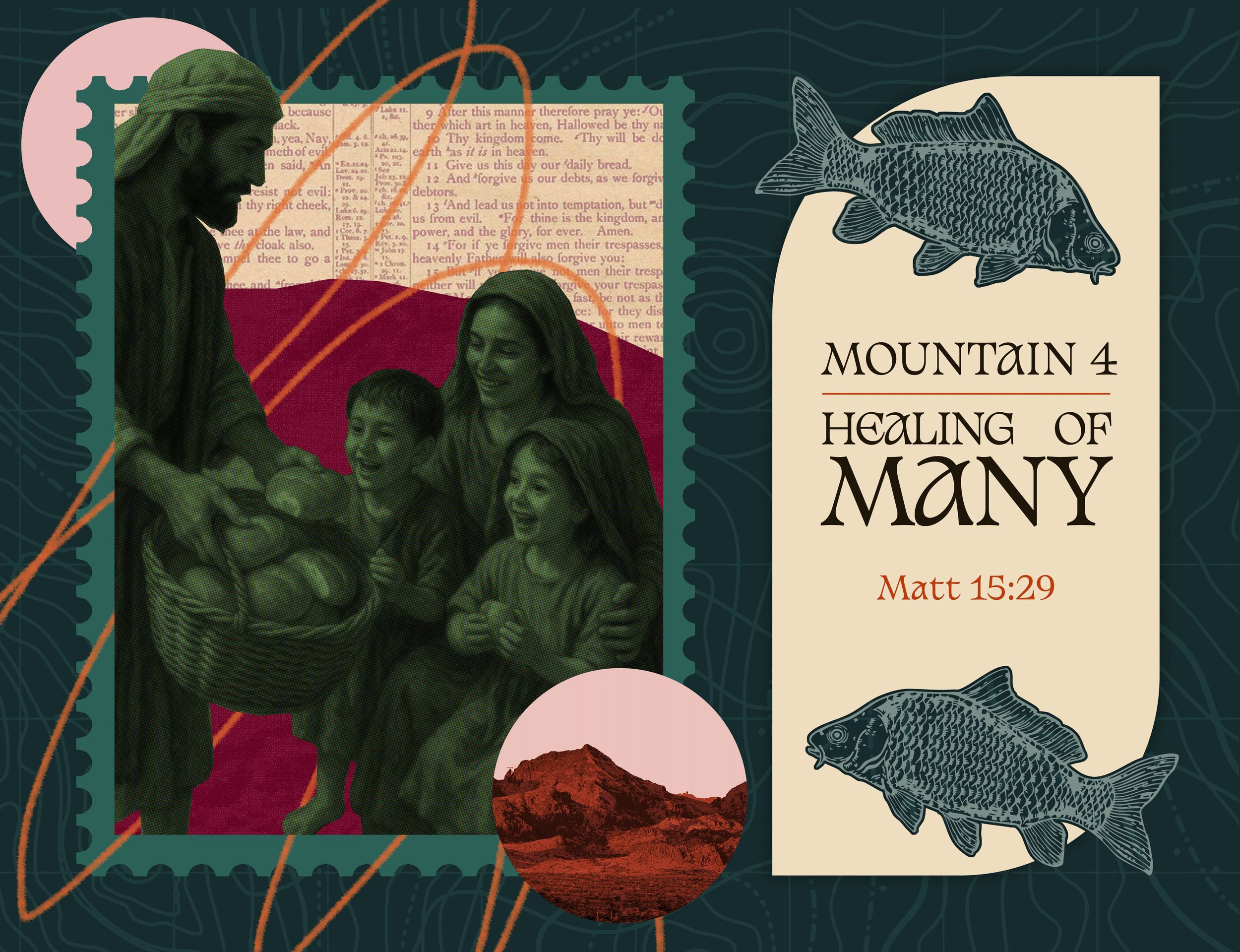
“Jesus left there and went along the Sea of Galilee. Then he went up on a mountainside and sat down.”
The fourth mountain in Matthew's Gospel, found in Matthew 15:29–39 and situated at the book's center, marks a turning point: Matthew shifts from recounting stories echoing Israel's history to offering a clear portrait of Jesus as the Messiah. Jesus ascends a mountain, sits down, and the crowds come to him. However, the people who gather around him are not impressive or accomplished. Rather, it is the desperate and the forgotten. Compassion defines the Messiah Matthew describes.
1. Jesus the Messiah
As pointed out in previous mountains, many in Jesus' day expected the Messiah to restore Israel through displays of political power and military strength. Militant Jewish groups such as the Zealots longed for liberation from Roman oppression and imagined a king in the mold of David or Joshua, a leader who would defeat Israel's enemies and establish God's kingdom through force. Matthew presents a very different picture.
“Great crowds came to him, bringing the lame, the blind, the crippled, the mute and many others, and laid them at his feet; and he healed them” (Matthew 15:30).
The Messiah Matthew introduces is not surrounded by the mighty but by the messy. Again and again throughout the Gospel, Jesus notices those society overlooks. He touches lepers, restores the excluded, and welcomes those considered beyond help. Matthew himself knew this grace personally. Before becoming a disciple, he had been a tax collector (Matthew 9:9-13). Tax collectors were people whom many viewed as cheats, traitors, and collaborators with the oppressive Romans. Here, Jesus reveals that God's Kingdom moves toward the wounded rather than away from them.
2. Jesus in the Middle
Matthew paints a striking image: Jesus seated on the mountain while people bring their suffering to him. The crowds come carrying their afflicted loved ones. The blind hope for sight, while the mute seek a voice. Many crippled come praying for healing. Jesus receives them all, taking his time with each of them. Throughout Scripture, mountains are often places where heaven and earth meet. Here, Matthew presents Jesus as the place where God's compassion intersects with human brokenness. Jesus does not remain distant from suffering. He steps into the middle of it.
This theme continues throughout the Gospel. Matthew repeatedly describes Jesus as being moved with compassion for the crowds because they are "harassed and helpless, like sheep without a shepherd" (Matthew 9:36). Even in this passage, Jesus says, "I have compassion for these people" (Matthew 15:32). Later at the crucifixion, Matthew records that Jesus is on the central cross between two criminals. Even in death, Jesus brings ultimate healing from the middle of our mess. Matthew's Gospel presents not simply a teacher with wise words or a king with great authority, but a Savior who draws near to human pain.
3. Jesus Provides Manna
Immediately following these healings, Jesus feeds the multitudes. This is the second time Matthew records such a miracle, and the disciples respond with the same confusion they displayed before. Despite witnessing God's provision, they struggle to trust that Jesus will provide again. Matthew intentionally echoes Israel's Exodus here. When the Israelites feared starvation, God provided manna from heaven. Yet even after experiencing God's faithfulness, they repeatedly forgot what God had done for them.
The disciples are no different. Later, after both miracles, Jesus asks them: “Do you still not understand? Don’t you remember the five loaves for the five thousand, and how many basketfuls you gathered?” (Matthew 16:9) Matthew reminds his readers that forgetfulness is part of the human condition. We easily lose sight of God's provision in the face of present needs. Yet Jesus remains faithful. His healing never ceases, and he welcomes us as we are. Through Jesus, we see God, who has always provided for his people. You just have to approach him.
The Center of This Gospel
The seven mountains of Matthew are not the primary way the Gospel is organized, but they offer a helpful lens for tracing Matthew's major themes. Matthew's Gospel was likely read aloud in public. Most people encountered these stories by hearing them aloud rather than reading them privately. Because of this, repetition and carefully arranged patterns helped listeners remember what they had heard.
One literary pattern Matthew appears to employ is called a chiastic structure. In a chiastic structure, themes introduced early in a work reappear later in reverse order, drawing attention to what stands at the center. If Matthew intentionally arranged these mountain scenes in this way, then this fourth mountain becomes especially significant. The first mountain of temptation mirrors the seventh mountain of commission. The second mountain of teaching corresponds with the sixth mountain of judgment and future hope. The third mountain of prayer parallels the fifth mountain of transfiguration. In the middle of all this stands this portrait of Jesus surrounded by those in need.
Whether or not Matthew intended readers to recognize every literary detail, the message is clear: the heart of Jesus' ministry is compassion. The Messiah Matthew presents is one who moves toward human brokenness with healing, provision, and mercy. If the mountains of Matthew help us understand who Jesus is, then this central mountain reveals what lies closest to his heart.
Keener, C. (1999). Feeding Four Thousand in the Wilderness (15:29-39). In A Commentary on the Gospel of Matthew (pp. 418–419). essay, W.B. Eerdmans Pub. Retrieved June 4, 2026, from https://archive.org/details/commentaryongosp0000keen/page/144/mode/2up.
Schweizer, E., & Green, D. E. (1975). The Good News According to Matthew. John Knox Press.