Mountain 5
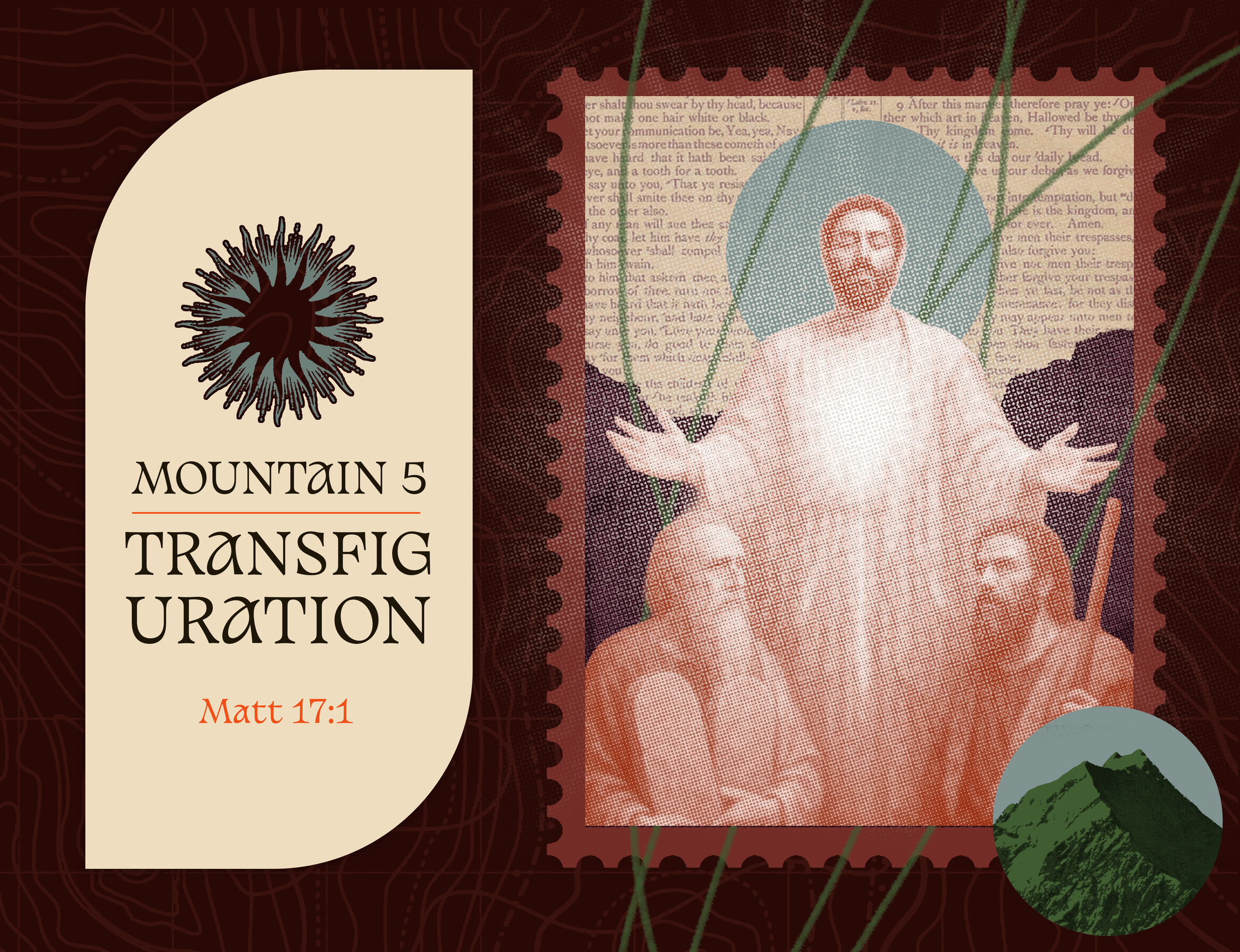
“After six days Jesus took with him Peter, James and John the brother of James, and led them up a high mountain by themselves”
The fifth mountain in Matthew's Gospel is perhaps the most dramatic. Jesus takes Peter, James, and John up a high mountain where they witness an extraordinary event known as the Transfiguration. In a moment filled with dazzling light, a thunderous voice, and figures from Israel's past, it can be easy to miss Matthew's central point. The Transfiguration is not merely a mystical experience. It is Matthew's clearest revelation of who Jesus truly is.
1. Glimpse of His Glory
The Transfiguration follows immediately after Jesus predicts his suffering, death, and resurrection for the first time. He concludes by telling his disciples: "Some who are standing here will not taste death before they see the Son of Man coming in his kingdom" (Matthew 16:28). Six days later, Jesus takes Peter, James, and John up the mountain. Matthew says that Jesus "was transfigured before them" (Matthew 17:2). The Greek word behind transfigured is the same word from which we get metamorphosis. It means “to change into another form”. For a brief moment, Jesus' divine glory is revealed.
Matthew surrounds this event with echoes of Israel's history. Moses encountered God's glory on Mount Sinai (Exodus 19, 33, and 34). The mountain trembled, clouds descended, and Moses' face shone after speaking with God. It was from this meeting that Moses received the tablets of the Law. So, Moses became associated with the Law. Elijah encountered God on the same mountain generations later. Though wind, fire, and earthquakes surrounded him, God ultimately spoke in a gentle whisper. It was powerfully personal moments with God like this that gave Elijah the association for all the Prophets. When Moses and Elijah appear beside Jesus, Matthew is making a profound claim: the Law and the Prophets point toward him.
2. Greater
This mountain is one of three moments in Matthew where Jesus is publicly affirmed by God. At Jesus' baptism, the Father declares, "This is my Son, whom I love." At the Transfiguration, the Father repeats those words but adds something new: "Listen to him" (Matthew 17:5). This command carries enormous significance. Moses received the Law on Mount Sinai and taught God's people how to live. Yet the Father now directs the disciples' attention to Jesus. The authority of Jesus surpasses even Israel's greatest commands. Matthew is not suggesting that Jesus abolishes what came before. Rather, Jesus fulfills and embodies it. The Law had been written on stone tablets, but now God's Word stands before them in flesh and blood. The disciples are invited to trust him, follow him, and listen to him.
3. Get Up and Go
Overwhelmed by what he witnesses, Peter offers to build shelters for Jesus, Moses, and Elijah. His response makes sense for the Jewish audience this is written to. In the Exodus story, the Tabernacle had been the place where God's presence dwelt among the people in the wilderness. Building a sacred space or a place to commemorate an encounter with God was a tradition throughout Israel’s history (Genesis 28:18-91, Joshua 4, 1 Samuel 7:12). Peter wants to remain on the mountain in the radiance of glory, but Jesus has other plans. After the encounter fades, Jesus touches the frightened disciples and says: "Get up. Don't be afraid" (Matthew 17:7).
The language Matthew uses echoes other moments of resurrection Jesus performs throughout this Gospel. The disciples rise, and together they descend the mountain. At the foot of the mountain, they immediately encounter human suffering. The remaining disciples have failed to help a boy oppressed by a demon. Matthew reminds us that mountaintop experiences are not the destination. This contrast feels closely reminiscent of the story of the Golden Calf in Exodus 32. Moments of revelation prepare us to return faithfully to the ordinary struggles of life and ministry. The glory of Christ is meant to transform how we live in the valleys of life.
Contrast with the Mountain of Prayer
The mountain of Transfiguration mirrors Matthew's earlier mountain of prayer. On the third mountain, Jesus withdraws from the crowds to pray alone. Prayer is portrayed as an intimate and private relationship between the Son and the Father. Again and again, Jesus seeks solitude before returning to the demands of ministry.
On this fifth mountain, that same relationship becomes visible. The Father's voice is heard publicly, and the Son's glory is revealed openly. Intimacy sustaining Jesus in private is now witnessed by others. This contrast becomes even more significant in light of what follows. From this point forward, Matthew's Gospel increasingly turns toward Jerusalem and the cross. Before the suffering begins, the disciples are given a glimpse of who Jesus truly is to sustain their faith through what is to come. The One who will be rejected is still the beloved Son and glorious King. Even though he walks toward the cross, he is still the fulfillment of the Law and the Prophets.
The mountain of prayer revealed Jesus' dependence upon the Father. The mountain of Transfiguration reveals the Father's delight in the Son. Together, these two mountains remind readers that glory and suffering are not opposites within Matthew's Gospel. Glory comes from a Hebrew word that means “weight”. Jesus is the only one strong enough to hold the weight of both. The disciples cannot remain on the mountain forever, and neither can we. Eventually, we are all called to follow Jesus back down the mountain and continue the work set before us, strengthened by the assurance of who he is.
Keener, C. (1999). The Son of Man’s Glory (16:28-17:13). In A Commentary on the Gospel of Matthew (pp. 436–440). essay, W.B. Eerdmans Pub. Retrieved June 4, 2026, from https://archive.org/details/commentaryongosp0000keen/page/144/mode/2up.
Schweizer, E., & Green, D. E. (1975). The Good News According to Matthew. John Knox Press.